Open Science, FAIR Data, and Data Management Plans
This course introduces key approaches to Open Science and research data management. The materials explain the role of FAIR data and the European Open Science Cloud (EOSC) in contemporary research practice, examine the data lifecycle, and demonstrate how a data management plan facilitates the organization of data collection, description, storage, dissemination, and reuse.
The initial version of the course was developed by the Research Data Management Competence Center of the National Academy of Sciences of Ukraine, based on presentations from training webinars held in 2026. The slides are organized into four thematic sections, with their original content and design preserved.
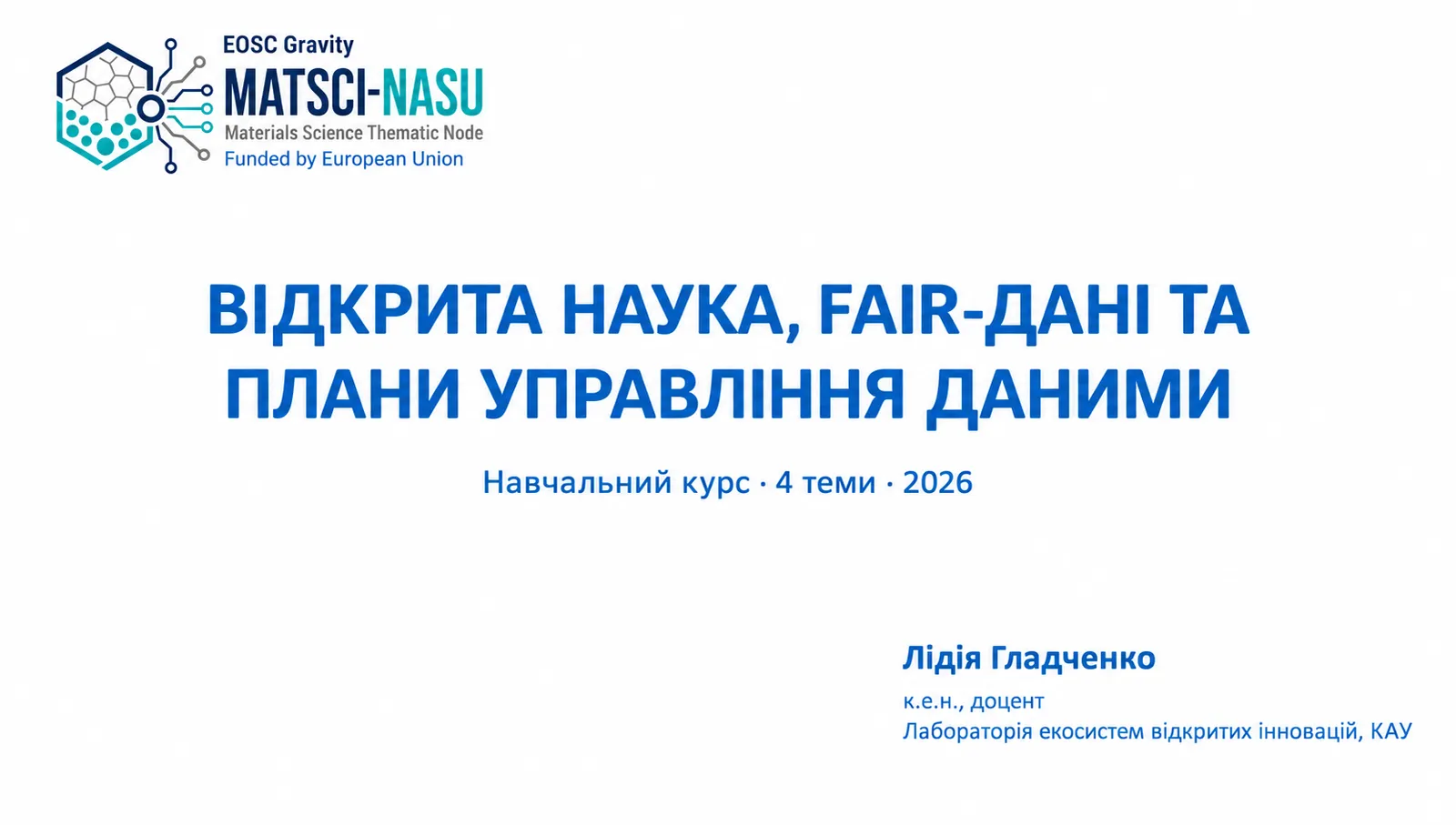
Course Profile
Access: Open
| Format: Self-paced online learning | Language: Ukrainian |
| Scope: 4 thematic modules | Learning materials: 4 presentations |
| Level: Basic | Version: 1.0, 2026 |
Target Audience
This course is designed for researchers, PhD candidates, principal investigators, data curators, repository staff, and professionals at research institutions who are responsible for the organization, preservation, or publication of research data.
No prior specialized training in data management is required.Learning Outcomes
Learning Outcomes
Upon completing the course materials, participants will be able to:
- explain the concept of Open Science and the role of the EOSC;
- distinguish between open data and data that adheres to the FAIR principles;
- describe the principles of Findability, Accessibility, Interoperability, and Reusability;
- explain the significance of metadata, persistent identifiers, licenses, machine-readable formats, and data provenance;
- identify the role of data management within the research lifecycle;
- describe the purpose and key components of a Research Data Management Plan.
Course Content
Topic 1. Open Science and EOSC
This topic provides an introduction to Open Science, explains the reasons for its development, and outlines the key stages of the transition from Open Access to the systemic management of research outputs. It covers the components of Open Science, the evolution of the FAIR principles, the role of the European Open Science Cloud (EOSC), and the benefits of EOSC for researchers. Special attention is given to the implementation of Open Science in Ukraine and the development of the corresponding infrastructure within the National Academy of Sciences of Ukraine.
Presentation length: 13 slides.
Topic materials:
Topic 2. FAIR Data and FAIR Principles
This topic explains the concept of FAIR data and how it differs from open data. It systematically covers the principles of being Findable, Accessible, Interoperable, and Reusable. The materials highlight the role of metadata, persistent identifiers, repositories, access conditions, and licenses. Specific sections are dedicated to machine-readable formats, controlled vocabularies, linked data, and the documentation of data provenance.
Presentation length: 16 slides.
Topic materials:
Topic 3. FAIR Workflow and Research Data Management
This topic explores the distinction between FAIR data and FAIR workflows. While FAIR data characterizes the properties of a research dataset, a FAIR workflow encompasses the sequence of operations, inputs and outputs, software, parameters, and the conditions under which a result is obtained. The topic also covers the concept of research data management and the stages of the research data lifecycle: planning, creation, processing, analysis, documentation, storage, publication, reuse, and archiving.
Presentation length: 6 slides.
Topic materials:
Topic 4. Research Data Management Plan
This topic focuses on the Research Data Management Plan (DMP) as a working document for a researcher, research group, or institution. It covers the purpose of the plan, the roles and responsibilities for its preparation, and tools such as DMPonline, DMPTool, ARGOS, and RDMO. The key components of a DMP are outlined, including: a description of the data and the methods used to acquire it; metadata; ethical and legal considerations; storage and security; terms for data dissemination; long-term preservation; the allocation of responsibilities; and the necessary resources.
Обсяг презентації: 6 слайдів.
Матеріали теми:
Recommended Learning Sequence
The topics are arranged in a sequence, progressing from the general context to a practical tool for data management. It is advisable to begin by exploring the concepts of Open Science and the EOSC, followed by the FAIR principles and the data lifecycle, before moving on to the structure of a Research Data Management Plan.
Authorship and Course Development
Author of the learning materials: Lidiia Hladchenko, PhD in Economics, Associate Professor, Open Innovation Ecosystems Laboratory at the Kyiv Academic University.
Course structuring and compilation of the initial version: Competence Center for Research Data Management, National Academy of Sciences of Ukraine.
The materials are based on presentations from webinars held in June and October 2026. The content is divided into four topics to facilitate independent, sequential study.