Preparing the README
We help researchers and research groups prepare clear, structured and reusable README files for datasets, software, workflows and FAIR data packages.
A good README explains what the files contain, how they were created, how they should be used, what software or methods are needed, how the dataset should be cited and what licence or access conditions apply.
Submit a consultation request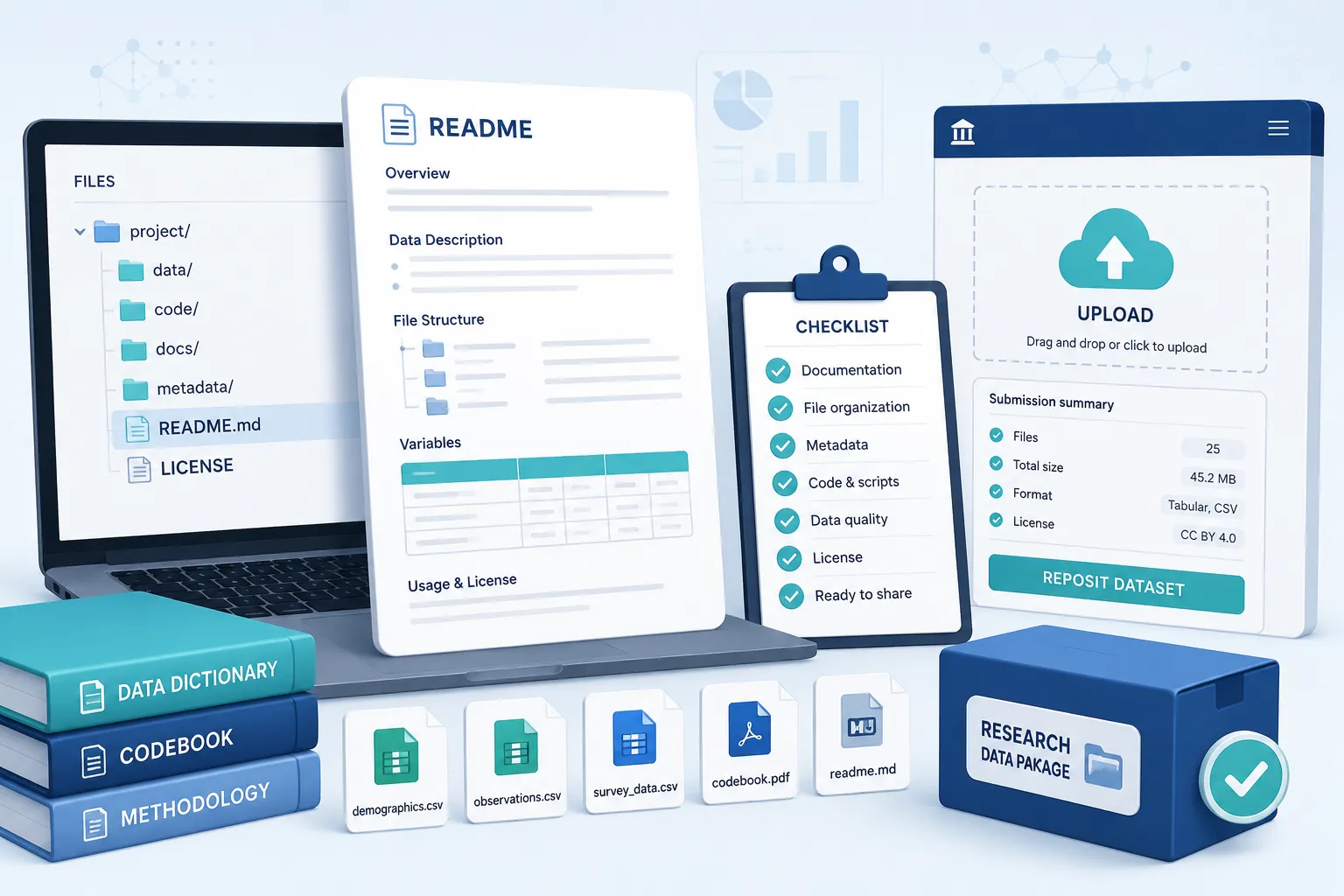
What this service supports
Dataset documentation
We help describe the content, structure, purpose and context of a dataset so that other users can understand and reuse it.
File structure explanation
We support the description of folders, files, formats, naming conventions, versions and relationships between files.
Reuse instructions
We help document how the data can be opened, processed, analysed or reused, including required software, scripts, parameters or workflow steps.
Citation and access information
We help include citation guidance, licence, access conditions, related publications, DOI or repository links.
How the process works
1. Request
You submit a consultation request and briefly describe the dataset, software, workflow or FAIR package that needs README support.
2. Initial review
The Competence Center reviews the available materials and identifies what type of README is needed.
3. File structure analysed
The structure of files, folders, formats and related documentation is reviewed.
4. README prepared
A README draft is prepared or improved using a structured template and good research data management practices.
5. Ready for publication
The README can be included in a DataverseUA deposit, FAIR data package, repository record or project documentation.
What users should prepare
To make the process efficient, users are encouraged to prepare:
- dataset or project title;
- short description of the dataset or research output;
- file list or folder structure;
- information about file formats;
- description of methods, instruments, software or workflows;
- related publication, project, DOI or repository link, if available;
- information about authors, contributors and contact person;
- licence or access conditions, if known;
- existing metadata or repository draft, if available;
- questions about how the data should be described or reused.
Expected outcomes
Depending on the request, the outcome may include:
- a complete README file;
- an improved README draft;
- recommendations on file organisation and documentation;
- clear explanation of dataset structure and file formats;
- instructions for data reuse;
- citation and licence information;
- links to related publications, datasets, software or workflows;
- README prepared for DataverseUA publication;
- README prepared as part of a FAIR data package;
- recommendations for improving dataset understandability and reuse potential.
README structure
A typical README for a research dataset may include:
- Dataset title and short description
A concise explanation of what the dataset contains and why it was created.
2. Authors and contact information
Names, affiliations and contact person responsible for the dataset.
3. File and folder structure
Description of files, folders, naming conventions, versions and relationships between files.
4. Methods and provenance
Information about how the data were generated, collected, processed or curated.
5. Software and dependencies
Software, scripts, notebooks, libraries, instruments or computational environments needed to use the data
6. Data formats
Description of file formats, units, variables, columns, parameters or metadata tables.
7. Licence and access conditions
Information on how the data may be reused and whether any restrictions apply.
8. Citation and related resources
Recommended citation, DOI, related publications, projects, software, models or workflows.
9.Reuse notes
Practical information for users who want to reproduce, validate, analyse or extend the dataset.
Submit a request
To request support with README preparation, please use the consultation request form.
Submit a consultation request