Data management plan
We help researchers, research groups and project teams prepare Data Management Plans for research projects, datasets and FAIR data publication workflows.
A Data Management Plan describes how research data will be collected, documented, stored, protected, shared, published and preserved during and after a research project.
Submit a consultation request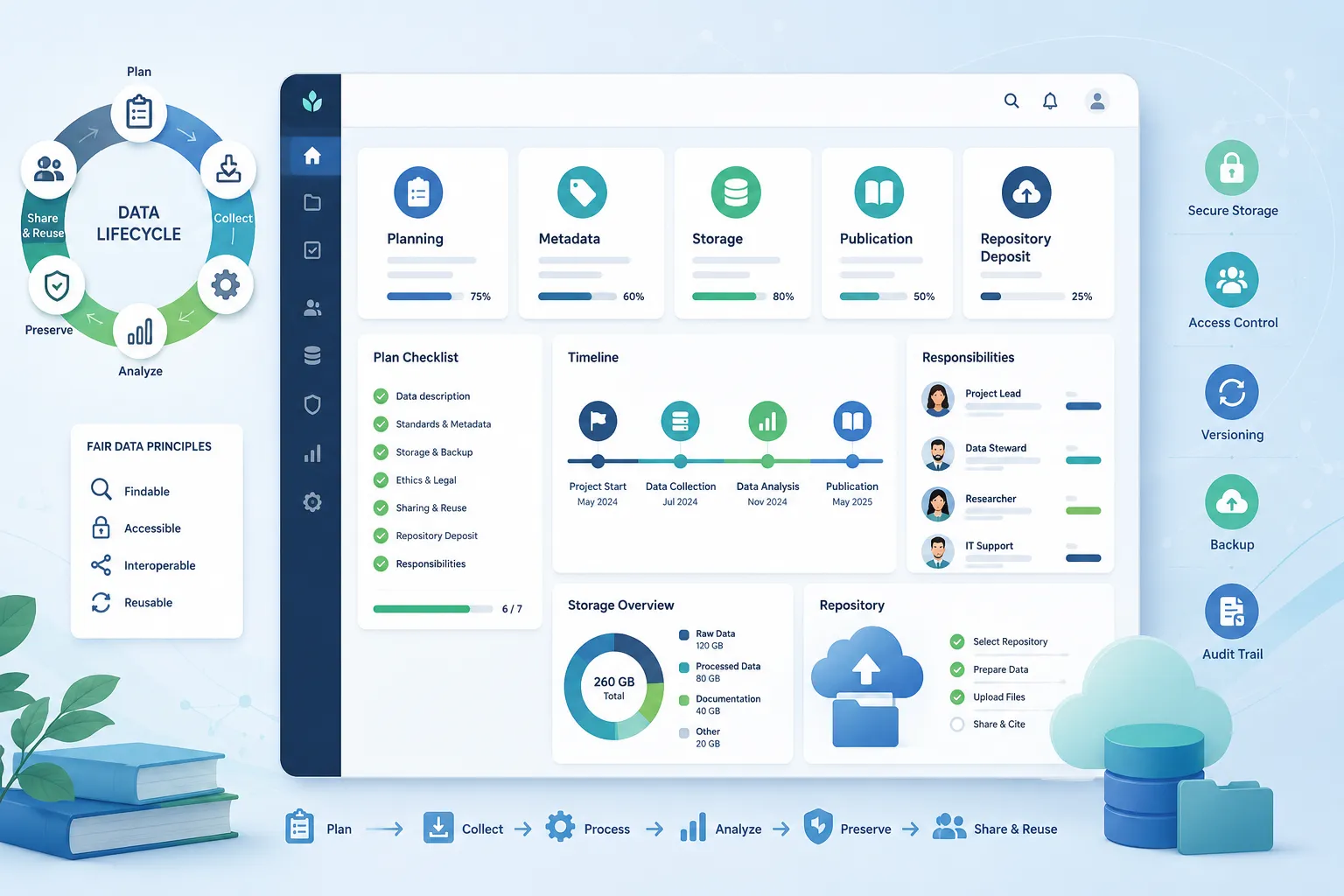
What this service supports
DMP structure
We help define the structure of a Data Management Plan according to the needs of the project, dataset, funder or institution.
Data lifecycle planning
We support planning across the data lifecycle: data collection, processing, documentation, storage, publication, sharing and preservation.
FAIR and open science alignment
We help align the DMP with FAIR principles, open science practices, repository publication and reuse requirements.
Repository and publication planning
We help plan where and how data will be published, documented, licensed and connected with publications, projects or other research outputs.
How the process works
1. Request
You submit a consultation request and briefly describe the project, dataset or research workflow that requires a Data Management Plan.
2. Initial review
The Competence Center reviews the project context, type of data, expected outputs, publication route and funder or institutional requirements.
3. DMP scope defined
The scope of the DMP is clarified: project-level DMP, dataset-level DMP, repository-oriented DMP or DMP fragment for a specific workflow.
4. DMP prepared or reviewed
The DMP is prepared, improved or reviewed with attention to data types, metadata, storage, access, licences, FAIR readiness and preservation.
5. Ready for project
The final DMP can be used for project documentation, institutional review, FAIR data preparation, repository deposit or data publication planning.
What users should prepare
To make the process efficient, users are encouraged to prepare:
- project title or working title;
- short description of the research project or dataset;
- type of data to be collected, generated or reused;
- expected data formats and approximate volume;
- methods, instruments, software or workflows used to produce the data;
- information about authors, contributors and responsible persons;
- expected repository or publication route;
- licence or access conditions, if known;
- information about sensitive, restricted or confidential data, if relevant;
- related publications, projects, grants, DOI records or repository links;
- existing DMP draft, if available;
- specific questions about data management, sharing, storage or publication.
Expected outcomes
Depending on the request, the outcome may include:
- a draft Data Management Plan;
- an improved DMP section or DMP fragment;
- recommendations on data organisation and documentation;
- recommendations on metadata and README preparation;
- recommendations on storage, backup and access conditions;
- recommendations on licences and reuse conditions;
- recommendations on repository publication in DataverseUA or another repository;
- recommendations on FAIR readiness;
- recommendations on OpenAIRE or EOSC compatibility;
- a practical list of next steps for the research group or project team.
What a DMP should cover
A Data Management Plan usually covers several core questions.
1. Data description What data will be collected, generated, processed or reused? What formats, volumes and data types are expected?
2. Documentation and metadata
How will the data be described? What metadata, README files, codebooks, manifests or documentation will be prepared?
3. Storage and backup
Where will the data be stored during the project? How will backup, versioning and file organisation be managed?
4. Access and sharing
Which data will be open, restricted, embargoed or closed? How will users access the data?
5. Legal and ethical issues
Are there personal, sensitive, confidential, copyrighted or restricted data? What conditions apply?
6. Licences and reuse
Which licence or terms of use will be applied? How should the data be cited and reused?
7. Repository publication
Where will the data be published or deposited? Will DataverseUA, another repository or a domain-specific repository be used?
8. FAIR readiness
How will the data become findable, accessible, interoperable and reusable?
9. Preservation and responsibility
Who is responsible for the data after the project? How long should the data be preserved and maintained?
Submit a request
To request support with a Data Management Plan, please use the consultation request form.
Submit a consultation request