MISSION
Our mission is to help researchers and research organisations manage, describe, publish and reuse research data responsibly by developing practical competencies, methodological resources and accessible support services.
The Centre promotes FAIR data practices, responsible research data management and the preparation of research outputs for trusted repositories, national services and international research infrastructures.
We connect researchers, data stewards, repositories, libraries, information technology specialists and research infrastructures so that research data can be managed consistently throughout its lifecycle.
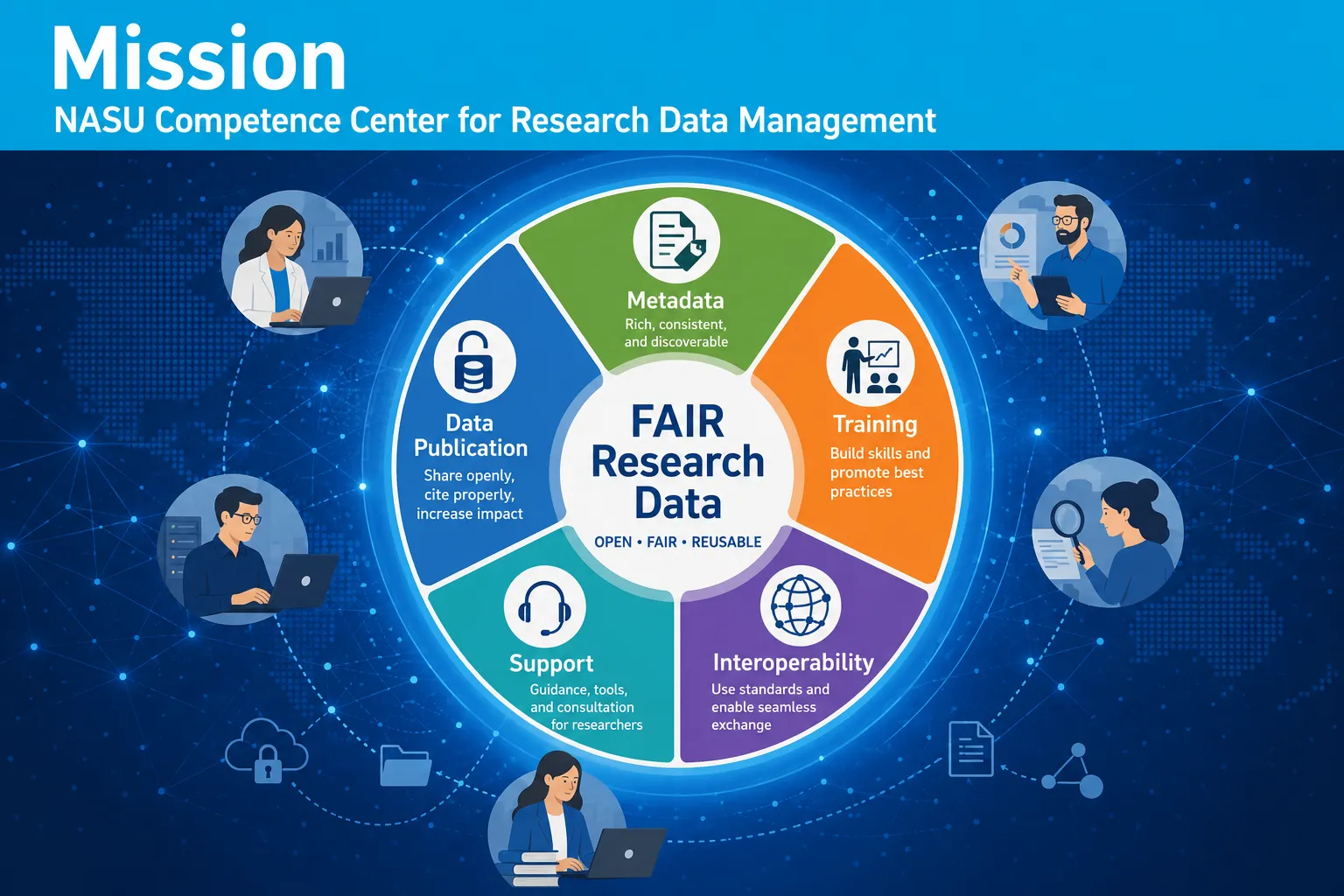
Our mission
The NASU FAIR Data Competence Center enables researchers and research organisations to apply FAIR principles and responsible research data management in everyday scientific practice.
We provide the knowledge, methodological resources, consultation, training and curation support needed to prepare research data and related digital objects for publication, preservation, citation, discovery and reuse.
We also support the readiness of research communities, services and institutions for interaction with DataverseUA, national catalogues, OpenAIRE, EOSC and other open-science infrastructures.
Why the Centre exists
Research data are increasingly created through complex experimental, computational and digital processes. Their long-term value depends on appropriate planning, documentation, metadata, preservation, access conditions and links to related research outputs.
Researchers and institutions therefore need coordinated methodological and practical support that connects disciplinary knowledge with repositories, metadata standards, digital tools and research infrastructures.
The Centre addresses this need by creating a shared competence environment for research data management within Kyiv Academic University, the National Academy of Sciences of Ukraine and the wider Ukrainian research community.
Mission priorities
Develop competencies
Strengthen the practical knowledge and skills of researchers, data stewards and research-support professionals.
Embed FAIR practices
Support the consistent application of FAIR principles throughout the research data lifecycle.
Enable trusted publication
Help prepare data, metadata, software and workflows for preservation, citation and reuse in repositories.
Build interoperability
Prepare research outputs and services for discovery and exchange across national and international infrastructures.
Strategic objectives
Support responsible data management: help research communities plan, organise, document, preserve, publish and reuse research data.
Translate principles into practice: provide templates, instructions, checklists, metadata profiles and examples that can be applied in real research workflows.
Improve research-object readiness: support the preparation of datasets, software, computational workflows, experimental results and accompanying documentation for repository publication.
Strengthen repository use: promote effective publication, preservation, citation and reuse through DataverseUA and other appropriate repositories.
Develop professional capacity: provide training and professional development for researchers, doctoral researchers, early-career researchers, data stewards, librarians and repository administrators.
Support infrastructure readiness: prepare data, metadata, resources and services for compatibility with national catalogues, OpenAIRE, EOSC and other open-science infrastructures.
Coordinate the support ecosystem: facilitate cooperation between researchers, repositories, libraries, IT units, laboratories, research infrastructures and partner organisations.
Guiding principles
Openness with safeguards
Promote open science while respecting personal data, intellectual property, confidentiality and security requirements.
Interoperability
Use standards, identifiers and structured metadata that support exchange between systems and research communities.
Quality and relevance
Review materials, update templates and use feedback to keep support aligned with current research practice.
Integrity and responsibility
Respect academic integrity, authorship, licensing, attribution and responsible management of research information.
From principles to research practice
The Centre focuses on practical implementation. FAIR and open-science principles become useful only when they are translated into documented actions, reusable resources and sustainable institutional processes.
Plan
Define how data will be created, organised, protected, documented, preserved and shared.
Document
Create metadata, README files, manifests, provenance descriptions and other supporting materials.
Publish
Prepare datasets and related research objects for trusted repository deposit and persistent identification.
Connect
Link data with people, organisations, publications, software, workflows, projects and infrastructures.
FAIR data as an operational objective
The Centre treats FAIR data as a practical result of coordinated research data management rather than as a formal declaration.
Findable: data are described with sufficient metadata and persistent identifiers.
Accessible: access conditions and procedures are clearly recorded.
Interoperable: metadata use appropriate standards, formats, identifiers and controlled vocabularies.
Reusable: data are accompanied by documentation, provenance, licence information and sufficient scientific context.
Developing research data competencies
Sustainable research data management requires distributed competencies across research organisations. The Centre therefore supports the development of researchers, data stewards and other professionals who participate in the research data lifecycle.
Researchers
Apply appropriate data-management, documentation and publication practices within research projects.
Data stewards
Provide specialised methodological and curation support to research teams and institutions.
Repository professionals
Support metadata quality, deposit workflows, preservation, access and interoperability.
Institutional support teams
Coordinate research, library, legal, administrative and technical responsibilities.
Intended outcomes
Better documented data
Research outputs are accompanied by metadata and documentation sufficient for interpretation and reuse.
Reusable FAIR packages
Data, software, workflows and supporting files are organised as coherent research packages.
Stronger institutional capacity
Research organisations develop repeatable processes and local competencies for managing research data.
Infrastructure-ready outputs
Research resources can be discovered and exchanged through repositories, catalogues and federated infrastructures.
Our mission within the research ecosystem
The Centre acts as a competence and coordination interface between research communities and the organisational and digital services needed for responsible research data management.
Its mission is implemented through cooperation with Kyiv Academic University, institutions of the National Academy of Sciences of Ukraine, higher education institutions, repositories, libraries, research infrastructures, shared research facilities, IT units and national and international partners.
Through this cooperation, the Centre supports a transition from isolated data-management practices to reusable methods, shared competencies and interoperable research services.
Explanatory status
This page presents the Centre’s mission in a public and explanatory form based on its approved institutional regulation.
The formal purpose, tasks, functions, governance and reporting requirements of the Centre are defined by the Regulation on the Centre for Research Data Management Competence.
Where the wording of this page and the approved Regulation differ, the official Regulation takes precedence.