Persistent identifier services
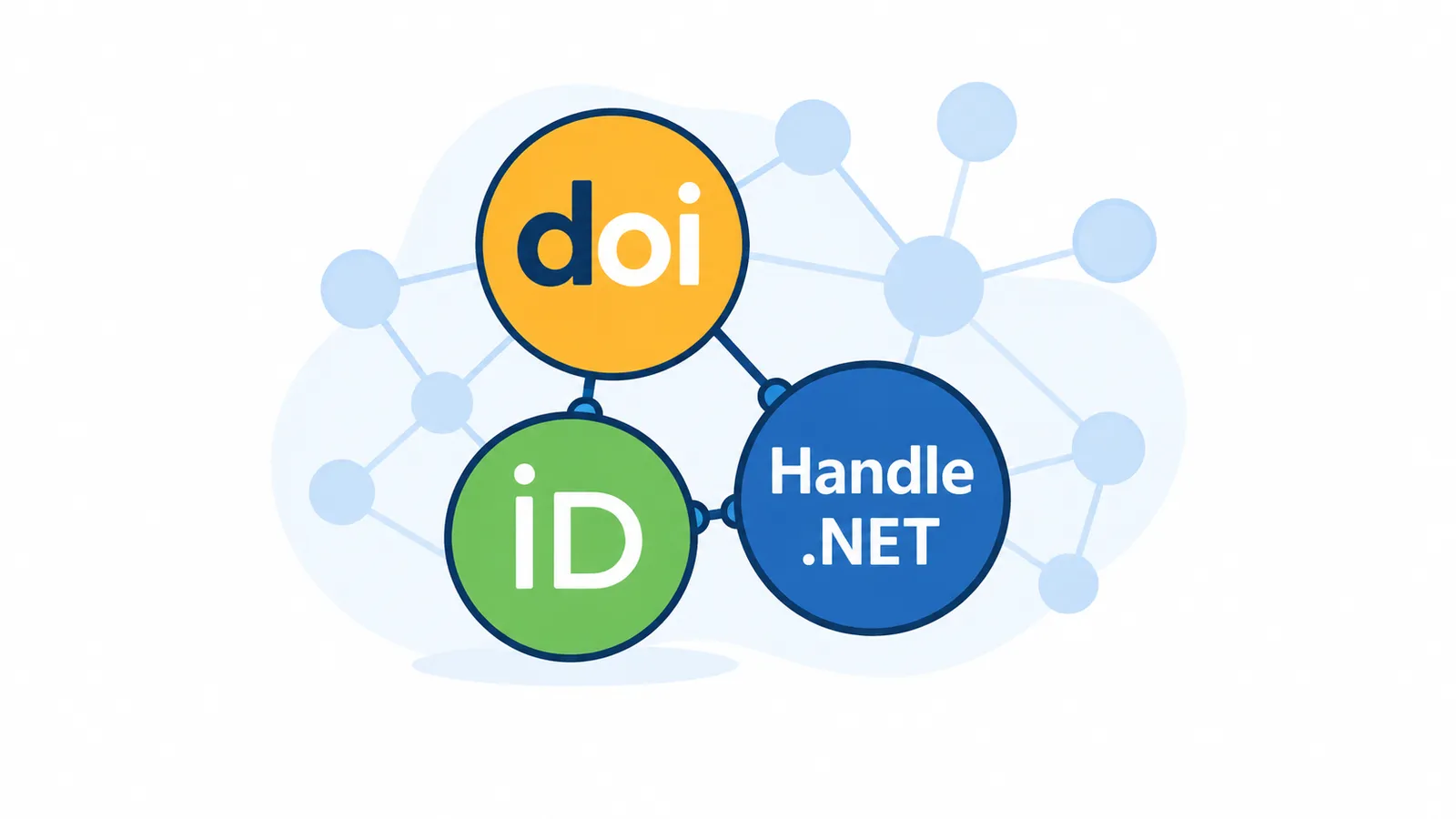
This page provides curated links to persistent identifier services used to identify, cite and connect research outputs, people, organisations, projects, physical samples, software and other research entities.
Select an identifier according to the type and granularity of the object. A dataset DOI, an ORCID iD, a ROR ID and a sample identifier perform different functions and should not be used interchangeably.
Resource information
Resource type
Curated directory of persistent identifier services, registries and resolvers
Intended users
Researchers, data stewards, curators, repository teams, librarians and infrastructure developers
Recommended use
During metadata preparation, repository publication, citation, project registration and research-object linking
Link status
External registries and services maintained by their respective organisations
Select an identifier by object type
Persistent identifier systems are specialised for different entities and research workflows.
Research outputs
Use DOI services for datasets, publications, software, workflows, models and other citable research outputs.
People and organisations
Use ORCID for individuals and ROR for research and funding organisations.
Projects and samples
Use RAiD for research activities and IGSN IDs for physical samples and sample collections.
Software and domain records
Use SWHIDs for precise source-code artefacts and recognised domain identifiers for database records.
An identifier is not automatically a persistent identifier
A local database number, file name or URL may identify an object within one system, but persistence additionally requires governance, maintenance and a commitment not to reassign the identifier to another object.
A persistent identifier should remain associated with the same object even when its location, metadata or responsible organisation changes.
Recommended starting points
Start with these services when identifying a research output, person or organisation or when exploring PID-based relationships.
DataCite
Global DOI registration and metadata infrastructure for research data, software, samples, workflows and other research resources.
Explore DataCite DOI servicesORCID
Persistent identifier and registry record for people involved in research, scholarship and innovation.
Create or manage an ORCID iDResearch Organization Registry
Global, community-led registry of open persistent identifiers for research and funding organisations.
Search the ROR RegistryDataCite Commons
Discovery, analytics and reporting environment based on relationships represented in DataCite DOI metadata.
Explore DataCite CommonsDOI services for research outputs
DOI services combine a persistent identifier, registered metadata and a maintained resolution target.
DataCite
DOI registration agency supporting identification and citation of datasets, software, models, workflows, samples and other research resources.
View DataCite servicesCrossref
DOI registration and metadata infrastructure widely used for journal articles, books, conference outputs, preprints, grants and other scholarly content.
View Crossref registrationDOI Foundation
Non-profit organisation governing the DOI system and its Registration Agencies under the DOI international standard.
Visit the DOI FoundationDOI Resolver
Resolution service directing a DOI to its currently registered landing page or another maintained destination.
Open DOI ResolverPeople, organisations and PID relationships
Use entity-specific identifiers rather than entering names only as uncontrolled text.
ORCID Registry
Registry of persistent identifiers and records for researchers, authors, contributors, curators and other research participants.
Open ORCID RegistryROR Registry
Open registry for identifying universities, research institutes, laboratories, funders and other research organisations.
Search RORDataCite Commons
Interface for examining relationships between research works, people, organisations and repositories represented in DataCite metadata.
Search DataCite CommonsCrossref Metadata Search
Search service for metadata of articles, books, standards, datasets and other content registered with Crossref.
Search Crossref MetadataProjects, samples and software identifiers
These identifier systems extend PID use beyond publications and datasets to research activities, physical objects and source code.
Research Activity Identifier
Persistent identifier and metadata registry for research projects and activities.
Explore RAiDIGSN ID
Globally unique and persistent identifier for physical samples and sample collections from any research domain.
Learn about IGSN IDsSoftware Heritage Identifier
Content-derived persistent identifier for precise software source-code artefacts archived or recognised by Software Heritage.
Explore SWHIDsIdentifiers.org
Registry and resolution service providing consistent access to recognised scientific database identifiers, with a strong focus on life sciences.
Open Identifiers.orgGeneral identifier infrastructure
These services provide general-purpose identifier and resolution mechanisms rather than identifiers dedicated to one research entity type.
Handle System
Distributed infrastructure for assigning, managing and resolving persistent identifiers for digital objects and other resources.
Visit Handle.NetArchival Resource Key
Open and decentralised persistent identifier designed to support long-term access to digital, physical and abstract objects.
Explore ARK identifiersdoi.org
Official proxy service for resolving DOI names to their registered destinations.
Open doi.orgIdentifiers.org Resolver
Resolution infrastructure transforming registered Compact Identifiers into stable, actionable web references.
Use the resolverResearchers usually obtain a DOI through a repository or publisher
Individual researchers normally do not register DataCite or Crossref DOIs directly. DOI registration is performed by an authorised member, consortium organisation, repository, publisher or another registered service provider.
For a research dataset, select an appropriate repository and confirm whether it assigns a DOI or another recognised persistent identifier during publication.
Persistent identifier selection checklist
Verify the following before selecting or recording an identifier.
Object type
Does the identifier scheme cover the dataset, person, organisation, project, sample or software object concerned?
Granularity
Does the identifier represent the complete object, one version, one file, one sample or a broader collection?
Governance and metadata
Is the identifier supported by a maintained registry, responsible organisation and sufficient descriptive metadata?
Resolution and relationships
Does it resolve correctly, and can it be connected to related people, organisations, outputs, projects and versions?
Good PID practice
Use the full actionable form
Record identifiers as complete HTTPS URLs where the identifier scheme recommends an actionable form.
Verify before publication
Open each DOI, ORCID iD, ROR ID and related identifier and confirm that it resolves to the intended entity.
State the identifier type
Preserve both the identifier value and its scheme, such as DOI, ORCID, ROR, RAiD, IGSN ID or SWHID.
Use typed relationships
Record whether an identified object is a version, component, source, supplement, documentation or derivation of another object.
Verify current registration and metadata requirements
Persistent identifier services may revise their metadata schemas, membership arrangements, APIs, fees, validation rules and supported resource types.
Consult the current provider documentation before implementing an identifier workflow in a repository, institutional information system or funded research project.