Skip navigation

Metadata and interoperability

This thematic glossary explains the concepts used to structure, exchange, interpret and validate research metadata across repositories, catalogues, research information systems and federated services.

It covers metadata records, schemas, standards, application profiles, mappings, controlled vocabularies, persistent identifiers, machine-readable formats and the technical and semantic dimensions of interoperability.

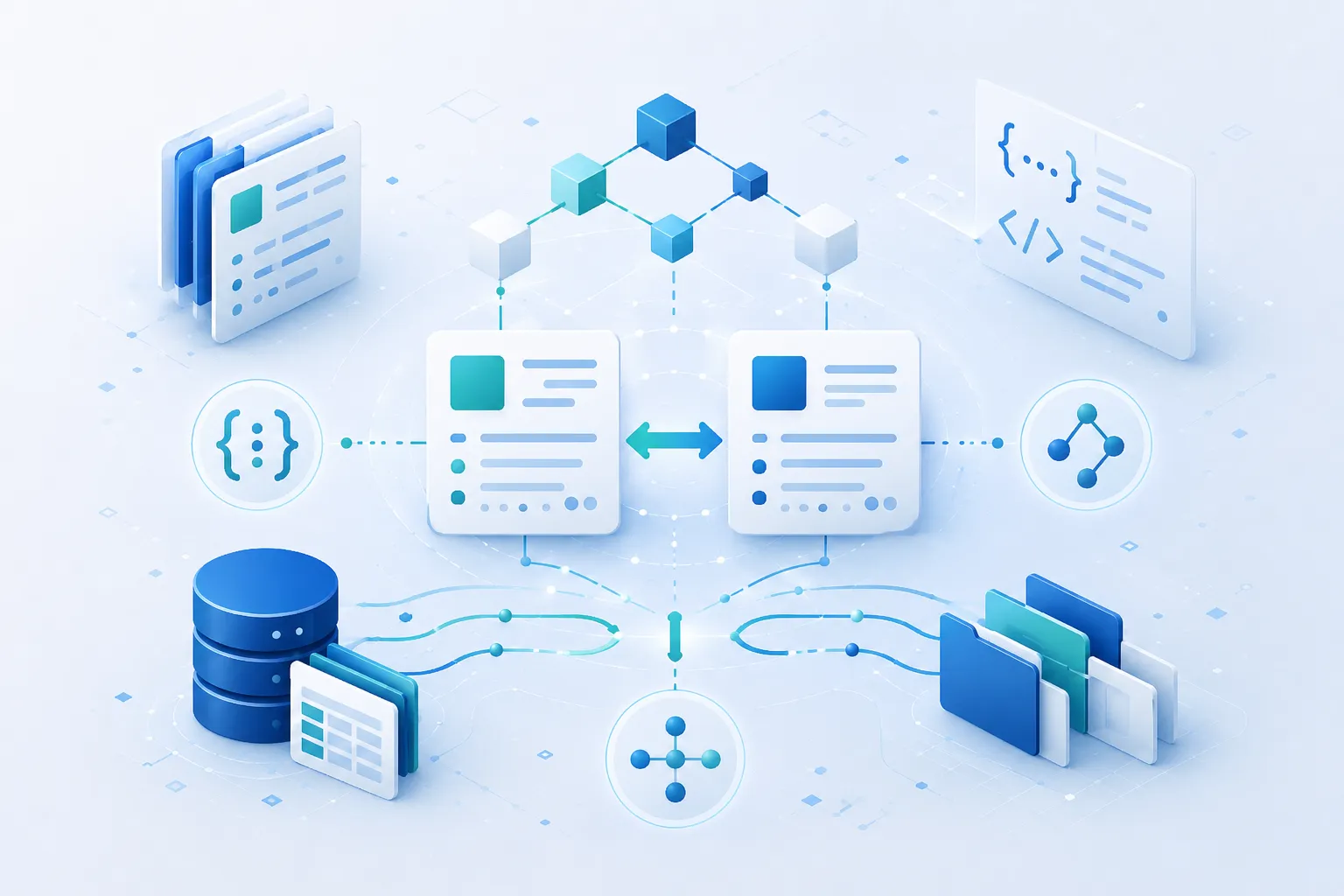
ChatGPT Image 26 лип. 2026 р., 14_22_12 (2)

Resource information

Resource type

Thematic glossary of metadata and interoperability terminology

Intended users

Researchers, data stewards, curators, repository managers and developers

Recommended use

During metadata preparation, profile design, mapping, export and repository integration

Language

Preferred English terms with Ukrainian equivalents

What do metadata and interoperability mean?

Metadata are structured information used to identify, describe, discover, interpret, manage and connect a dataset or another research object.

Interoperability is the ability of different systems, organisations and communities to exchange information and preserve its structure and meaning.

Exchange alone is not sufficient

Two systems may technically transfer a metadata file but still interpret its fields differently. Effective interoperability requires compatible formats, documented structures, shared semantics, controlled values and stable identifiers.

Core metadata building blocks

Metadata interoperability depends on the coordinated use of structures, semantics, identifiers and technical representations.

Structure

Fields, properties, value types, cardinalities and relationships defined by a schema or application profile.

Semantics

Definitions that specify the intended meaning of properties, concepts and controlled values.

Identifiers

Stable identifiers for datasets, people, organisations, vocabularies and related research objects.

Representation

Technical formats such as JSON, XML, JSON-LD or RDF used to store and exchange metadata.

Levels of interoperability

Interoperability includes several complementary levels. Successful metadata exchange normally requires all four.

Technical

Systems can connect and transfer metadata through compatible protocols, interfaces and services.

Syntactic

Metadata are represented in agreed structures and formats that receiving systems can parse.

Semantic

The meaning of properties, values and relationships is preserved across systems and communities.

Organisational

Responsibilities, policies, workflows and governance arrangements support reliable metadata exchange.

Browse terms

Select a letter to move to the corresponding glossary section.

A

Application profile

Ukrainian: профіль застосування метаданих

A documented selection and constraint of properties from one or more metadata standards for a specific community, repository, discipline or information system.

An application profile defines which properties are used, whether they are mandatory, how often they may occur, which value types or vocabularies are accepted and how records are validated.

C

Cardinality

Ukrainian: кардинальність; допустима кількість повторень

A rule specifying the minimum and maximum number of times a metadata property may occur in a record.

Common cardinalities include exactly one, zero or one, one or more, and zero or more occurrences.

Controlled vocabulary

Ukrainian: контрольований словник

An organised set of approved terms or codes used to represent values consistently in metadata.

A controlled vocabulary reduces spelling variations and ambiguity and may provide definitions, identifiers, relationships and multilingual labels.

Metadata crosswalk

Ukrainian: таблиця відповідності метаданих; кросворк метаданих

A documented mapping between properties in two metadata schemas, standards or application profiles.

A crosswalk should indicate whether mappings are exact, broader, narrower, conditional or unsupported and whether any information is lost during transformation.

D

Data dictionary

Ukrainian: словник даних

Documentation describing the variables, columns, fields, codes, units, valid values and missing-value conventions used within a dataset.

A data dictionary explains the internal structure of the data, while dataset-level metadata describe the dataset as a complete research object.

Data model

Ukrainian: модель даних

A conceptual or technical representation of entities, properties, relationships and constraints within an information system.

A data model determines how information is structured and may be implemented in relational tables, documents, graphs or other technical forms.

Descriptive metadata

Ukrainian: описові метадані

Metadata that identify and describe the content and context of a resource.

Examples include title, creator, description, subject, keywords, dates, resource type and related research outputs.

Discovery metadata

Ukrainian: метадані для пошуку та виявлення

Metadata selected and exposed to support searching, filtering, indexing and identification of a resource.

Discovery metadata usually include identifiers, titles, creators, subjects, descriptions, resource types, dates and access information.

E

Encoding scheme

Ukrainian: схема кодування значень

A documented convention that defines how a metadata value should be represented or interpreted.

Encoding schemes may define date formats, language codes, identifier schemes, media types or controlled-value lists.

I

Identifier scheme

Ukrainian: схема ідентифікаторів

A defined system for assigning and interpreting identifiers for a particular type of object.

Examples include DOI for research outputs, ORCID for people and ROR for research organisations.

Interoperability

Ukrainian: сумісність; інтероперабельність

The ability of systems, organisations or communities to exchange information and use it while preserving the intended structure and meaning.

Interoperability may include technical, syntactic, semantic and organisational dimensions.

J

JSON

Full name: JavaScript Object Notation · Ukrainian: формат JSON

A text-based format for representing structured information through objects, properties, arrays and values.

JSON is widely used for APIs, configuration files, machine-readable metadata and local FAIR data packages.

JSON-LD

Full name: JSON for Linked Data · Ukrainian: JSON для пов’язаних даних

A JSON-based representation that connects properties and values to formally identified semantic concepts.

JSON-LD uses contexts and URIs so that metadata can be interpreted as linked data while retaining a JSON structure.

L

Linked data

Ukrainian: пов’язані дані

A method of publishing structured information using stable identifiers and explicit relationships between identified entities.

Linked data allow datasets, people, organisations, publications, concepts and services to be connected across systems.

M

Machine-actionable metadata

Ukrainian: машинодієві метадані

Metadata structured so that software can not only read the values but also interpret them and perform defined operations with limited human intervention.

Machine actionability depends on formal properties, identifiers, controlled values, explicit relationships and documented rules.

Machine-readable metadata

Ukrainian: машиночитані метадані

Metadata represented in a structured format that software can parse and process.

Machine readability does not by itself guarantee that software understands the meaning of every field or can act on the information automatically.

Metadata

Ukrainian: метадані

Structured information used to identify, describe, discover, interpret, manage and connect a resource.

Metadata may describe datasets, files, software, people, organisations, instruments, services, workflows or other research objects.

Metadata element or property

Ukrainian: елемент або властивість метаданих

A defined component of a metadata record used to represent a particular characteristic or relationship.

Examples include title, creator, publication date, licence, resource type and related identifier.

Metadata profile

Ukrainian: профіль метаданих

A documented set of metadata properties and rules selected for describing a defined type of resource or supporting a defined use case.

A profile may be a formally specified application profile or a simpler documented set of recommended fields.

Metadata record

Ukrainian: запис метаданих

A structured collection of metadata values describing one identified resource.

A metadata record may be displayed on a repository landing page, stored in a local file, exposed through an API or supplied through a harvesting interface.

Metadata schema

Ukrainian: схема метаданих

A formal specification defining metadata properties, structures, value types, cardinalities and technical representations.

A schema may also provide validation rules and controlled-value lists for machine-readable records.

Metadata standard

Ukrainian: стандарт метаданих

An agreed specification defining how metadata should be structured, interpreted or exchanged for a particular domain or type of resource.

A standard may define properties, obligations, controlled values, identifier schemes, technical formats and governance procedures.

Metadata validation

Ukrainian: валідація метаданих

The process of checking whether a metadata record satisfies defined structural, syntactic, semantic and consistency rules.

Validation may check mandatory fields, cardinality, data types, controlled values, identifier syntax, relationships and cross-field conditions.

N

Namespace

Ukrainian: простір імен

A defined context that distinguishes properties, classes or identifiers belonging to a particular vocabulary or schema.

Namespaces prevent terms with similar local names from being confused and commonly use URI-based identifiers.

O

Ontology

Ukrainian: онтологія

A formal representation of concepts, entities, properties and relationships within a domain.

Ontologies support semantic interoperability by allowing machines to interpret explicitly defined concepts and relationships.

P

Provenance metadata

Ukrainian: метадані походження; метадані провенансу

Metadata describing the origin, history, processing and derivation of a digital object.

Provenance may identify source objects, activities, software, instruments, people, organisations, dates, parameters and relationships between inputs and outputs.

R

RDF

Full name: Resource Description Framework · Ukrainian: модель опису ресурсів RDF

A graph-based model for representing identified resources and relationships as subject–property–object statements.

RDF supports linked data, semantic vocabularies and the integration of information from different systems.

S

Semantic interoperability

Ukrainian: семантична сумісність

The ability of systems and communities to exchange information while preserving and correctly interpreting its meaning.

Semantic interoperability is supported by shared definitions, controlled vocabularies, ontologies, persistent concept identifiers and explicit relationships.

Serialization

Ukrainian: серіалізація

The representation of a data or metadata model in a format that can be stored, transmitted and reconstructed.

JSON, XML and JSON-LD are examples of formats that may be used to serialize structured metadata.

Syntactic interoperability

Ukrainian: синтаксична сумісність

The ability of systems to exchange and parse information using agreed structures, formats and encoding rules.

Syntactic compatibility does not guarantee that receiving systems interpret the exchanged values in the same way.

T

Taxonomy

Ukrainian: таксономія

A hierarchical organisation of concepts into broader and narrower categories.

Taxonomies support classification, browsing and filtering but may express fewer relationship types than a formal ontology.

Technical interoperability

Ukrainian: технічна сумісність

The ability of information systems to connect and exchange data through compatible protocols, interfaces and technical services.

Examples include APIs, harvesting protocols, authentication mechanisms and supported network interfaces.

Thesaurus

Ukrainian: тезаурус

A controlled vocabulary that documents preferred terms, synonyms and semantic relationships such as broader, narrower and related concepts.

A thesaurus supports consistent indexing and helps users find resources through alternative terminology.

U

URI

Full name: Uniform Resource Identifier · Ukrainian: уніфікований ідентифікатор ресурсу

A standardised identifier used to identify a resource, concept, property or vocabulary term.

A URI may also function as a web address, but its primary role in metadata is stable identification.

V

Vocabulary

Ukrainian: словник термінів; словник значень

A documented set of terms or identifiers used to represent concepts, categories, properties or values.

A vocabulary may be a simple value list or a more structured taxonomy, thesaurus or ontology.

X

XML

Full name: Extensible Markup Language · Ukrainian: розширювана мова розмітки

A text-based language for representing structured information through nested elements and attributes.

XML is commonly used with formal schemas for metadata exchange, repository harvesting and automated validation.

Commonly confused concepts

The following concepts are related but should not be treated as interchangeable.

Schema and profile

A schema defines a general structure. A profile selects and constrains that structure for a particular use case.

Readable and actionable

Machine-readable metadata can be parsed. Machine-actionable metadata can support automated decisions or operations.

Syntax and semantics

Syntax defines representation. Semantics define the intended meaning of the information.

Vocabulary and ontology

A vocabulary provides terms. An ontology formally models concepts, properties and relationships.

How to use these terms

Prepare records

Use the terminology while completing metadata templates and repository records.

Develop profiles

Distinguish schemas, standards, profiles, obligations and controlled values.

Map metadata

Document the meaning and limitations of mappings between systems.

Validate exports

Check both technical syntax and the preservation of semantic meaning.

Explanatory status

These definitions provide practical explanations for metadata preparation and interoperability work. Where a term has a formal definition in a standard, vocabulary, schema or technical specification, the authoritative source takes precedence.