Scientific Team Roadmap: From a Computational Workflow to a FAIR Research Package
This page helps a scientific team move step by step from an already completed computational workflow to a documented, validated, and published FAIR research package.
The roadmap brings together training materials, guidelines, metadata profiles, checklists, and services of the NASU RDM Competence Center into a single sequence of practical actions.
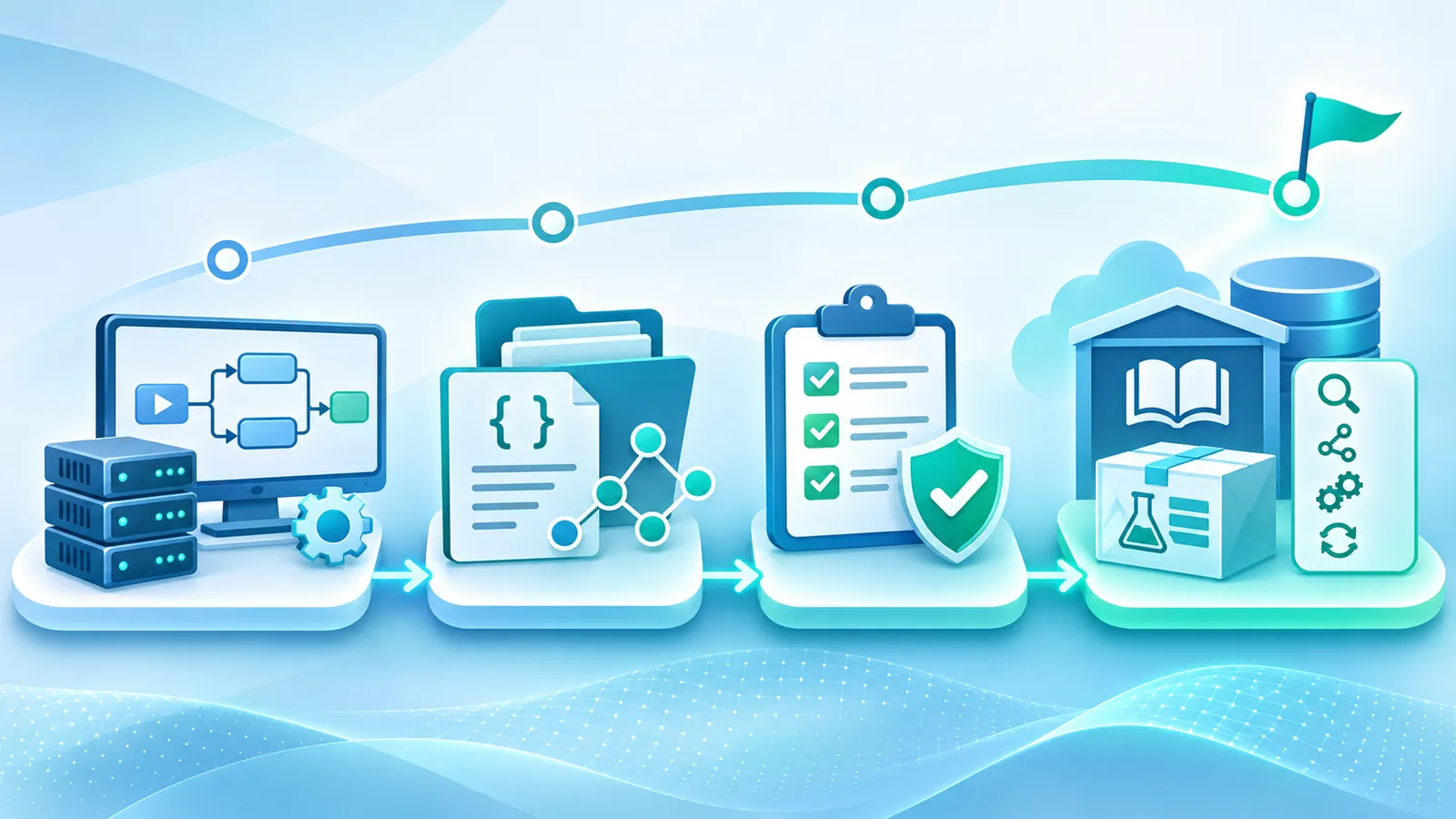
Who this roadmap is for
The roadmap is intended for scientific teams that already have a real computational workflow and want to transform its outputs into a structured and reusable research object.
The main participants are:
- researchers who perform the computational workflow;
- the scientific team’s data curator;
- software and computing infrastructure specialists;
- FAIR data and metadata experts from the Competence Center.
A team does not need to use every MATSCI-NASU metadata profile. It should select only those modules that correspond to the stages actually present in its own workflow.
Implementation roadmap
Goal of the stage
Appoint the responsible data curator, select one specific completed workflow, and prepare its initial dataset for work in DataverseUA.
What the team does
- Appoints the scientific team’s data curator.
- Selects one specific completed computational workflow that will be used as the project use case.
- Identifies the files belonging to this workflow: input, output, scripts, configurations, documentation, and results.
- The curator obtains access to DataverseUA and becomes familiar with the process of creating, describing, and publishing a dataset.
- The team prepares the initial dataset: files, README, and basic repository metadata.
- A draft dataset is created in DataverseUA.
Competence Center materials
Expected result
- a designated data curator;
- a selected specific workflow;
- the main files collected and structured;
- a prepared README;
- basic dataset metadata prepared;
- a draft dataset created in DataverseUA.
The dataset created at this stage captures the initial state and provides the basis for further documentation. The complete workflow structure, provenance, links between stages, and manifest are developed during the following stages.
Before moving to Stage 2
The team should have:
- a designated curator;
- one specific workflow;
- an initial structure of its files;
- a README;
- a draft dataset in DataverseUA.
Goal of the stage
Transform the completed computational workflow into a formally documented FAIR workflow: define its boundaries, stages, transitions, inputs, outputs, software, and file structure.
Step 1. Complete the training
The data curator and representatives of the scientific team complete the course on documenting FAIR workflows.
FAIR Workflows in Computational Materials ScienceStep 2. Define the scientific logic of the workflow
Describe the actual sequence of the research process:
INPUT
  ↓
STAGE 1
  ↓
INTERMEDIATE RESULT
  ↓
STAGE 2
  ↓
...
  ↓
FINAL RESULT
For each stage, identify:
- the scientific operation;
- input;
- output;
- software;
- software version;
- configuration files;
- parameters affecting the result;
- the relation to preceding and following stages.
Step 3. Build the file structure
Create a logical structure of the research package. For example:
research-package/
├── README.md
├── dataset.json
├── workflow.json
├── provenance.json
├── manifest.json
├── LICENSE
│
├── stage-1/
│   ├── input/
│   ├── output/
│   ├── config/
│   └── scripts/
│
├── stage-2/
│   ├── input/
│   ├── output/
│   ├── config/
│   └── scripts/
│
└── results/
Step 4. Create draft workflow metadata
Parallel infrastructure track
At the same time, the team compiles a list of software packages, versions, libraries, dependencies, and computing resources required to execute the workflow, and prepares a plan for deploying them on the computing infrastructure.
Technical rules for access and software installation are defined by the relevant cluster provider. In the FAIR research package, this information is used to document the execution environment.
Expected result
- a FAIR workflow concept;
- a scheme of stages and transitions;
- a list of inputs and outputs;
- a research package file structure;
- a draft
workflow.json; - a list of software and dependencies;
- a plan for deploying software packages on the cluster.
Before moving to Stage 3
For every workflow stage, it should be clear:
what is performed → with which software → from which input → with which parameters → what output is produced → where that output goes next.
Which metadata profiles to use
Once the workflow structure has been defined, the team selects only those profiles that correspond to its actual research process.
| What is being described | Profile |
|---|---|
| The research package as a whole | Dataset Metadata Guidelines |
| The material or system under study | Material Metadata Guidelines |
| DFT calculation | DFT Metadata Guidelines |
| Machine-Learning Interatomic Potential | MLIP Metadata Guidelines |
| ML model hyperparameter tuning | Hyperparameter Tuning Metadata Guidelines |
| Molecular Dynamics | Molecular Dynamics Metadata Guidelines |
| The logical structure of the process | Workflow Metadata Guidelines |
| The actual execution history | Provenance Metadata Guidelines |
| The actual file inventory of the package | Manifest Metadata Guidelines |
Goal of the stage
Test the documentation scheme on the actual workflow, generate structured metadata, provenance and manifest, and introduce automated or semi-automated elements of documentation.
Step 1. Execute the workflow in a controlled environment
The team runs the workflow on its local server or another defined environment and checks whether the actual execution corresponds to the designed file structure.
Step 2. Complete stage metadata
Appropriate metadata records are created for the stages that were actually performed.
Metadata are extracted from real inputs and outputs, configuration files, logs, and other evidence sources.
Step 3. Record what actually happened
Create
provenance.json,
answering the following questions:
WHO / WHICH SOFTWARE
        ↓
PERFORMED WHICH OPERATION
        ↓
USED WHICH OBJECTS
        ↓
GENERATED WHICH RESULTSStep 4. Automate what can be extracted from files
For the specific workflow, the team identifies which metadata can be extracted automatically or semi-automatically from input files, output files, logs, configuration files, and the software environment.
The result may include scripts, extractors, or generators that create structured JSON records without repeated manual data entry.
Step 5. Generate the manifest
Once the actual package has been assembled,
create
manifest.json
containing the file inventory,
file sizes, and SHA-256 checksums.
Step 6. Perform three levels of validation
Does the JSON conform to the formal schema?
Are files, paths, identifiers, checksums, and cross-references mutually consistent?
Is there enough information for a researcher to understand and reproduce the relevant stage?
Expected result
- the workflow has been tested in real execution;
- metadata records have been prepared for relevant stages;
workflow.jsonhas been prepared;provenance.jsonhas been prepared;manifest.jsonhas been prepared;- scripts/extractors have been created for automated documentation tasks;
- a FAIR research package v0.x has been prepared;
- gaps to be resolved before publication have been identified.
Before moving to Stage 4
The package should pass three checks:
Schema-valid → Package-consistent → Scientifically sufficient
Goal of the stage
Validate the workflow in the target computing environment, fix the final release, and publish the FAIR research package in DataverseUA.
Step 1. Deploy software on the cluster
Together with the infrastructure provider, the team installs or enables the required software packages and dependencies and verifies that they operate correctly.
Step 2. Execute the workflow
Run the workflow in the target environment and verify that the documentation scheme operates together with the real computational process.
Step 3. Fix the release
Determine exactly which versions of data, software, models, scripts, and results belong to the publication release.
Step 4. Update the final metadata
After the final execution:
- update stage metadata;
- update
workflow.json; - update
provenance.json; - regenerate
manifest.json; - complete
dataset.json; - check the README, licence, and access conditions.
Step 5. Perform the publication check
DataverseUA deposit checklistData publication in DataverseUA
Step 6. Publish the dataset
After curator review, the package is published in DataverseUA and receives a persistent identifier.
Final result
- a published dataset in DataverseUA;
- a persistent identifier / DOI;
- a FAIR workflow metadata package;
- structured stage metadata;
- workflow, provenance, and manifest;
- a documented software environment;
- a validated and reusable research object.
What the final FAIR research package should contain
FAIR RESEARCH PACKAGE

README.md
dataset.json
workflow.json
provenance.json
manifest.json
LICENSE

+ metadata profiles for the stages actually performed
+ input / output / configuration files
+ scripts / notebooks / extractors
+ software environment information
+ model documentation, where applicable
+ validation / curation evidence
The objective is not simply to publish a collection of files, but to create a research object in which it is possible to trace:
what was studied → what was performed → with which tools → from which data → which results were obtained → how they are connected → where the files are located → how they can be validated and reused.
If the team does not know what to do next
If questions arise concerning metadata, FAIR package structure, DataverseUA, provenance, licences, or the choice of the next step, the team can contact the Competence Center.
Resource type: practical FAIR workflow implementation roadmap.
Target audience: scientific teams, data curators, data stewards, and participants in computational research projects.
Recommended slug:
scientific-team-roadmap-fair-research-package