ERA in Practice: From European Priorities to Institutional Change
How can European research policy priorities be translated into the everyday practices of research organisations? The European Commission’s guide ERA in Practice — A Guide for the R&I Community explains this connection through practical tools, project examples and support mechanisms. Published in 2026, it was prepared by the Directorate-General for Research and Innovation with support from the INSPIRING ERA project. The guide reviews achievements under the European Research Area (ERA) Policy Agenda 2022–2024 and outlines activities envisaged for 2025–2027.
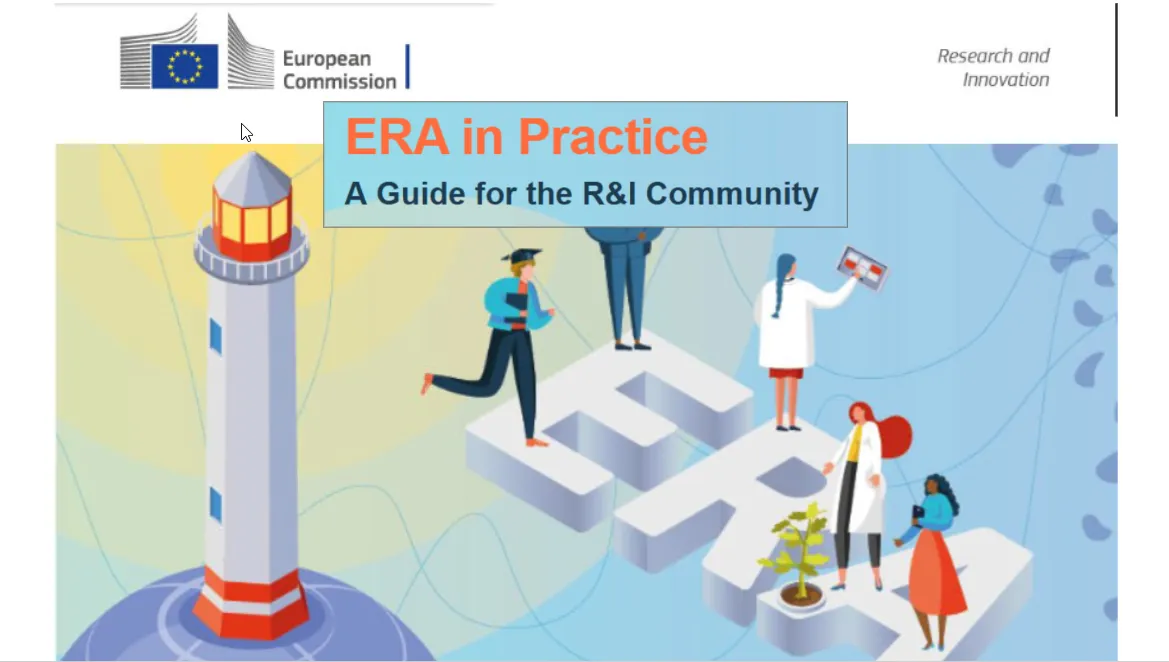
The guide covers four priorities: developing a common market for knowledge, advancing the green and digital transitions, widening access to research excellence, and coordinating investment and reforms. Each topic is considered from the perspectives of researchers, institutional leaders and research management professionals. This structure helps readers identify the decisions required at different levels and understand how they affect one another.
A recurring theme is the integration of change into established institutional practices. Creating a digital service requires funding for its operation and user support. Opening research outputs depends on staff competencies, legal conditions and incentives. International cooperation relies on an organisation’s capacity to manage projects, maintain quality and fulfil shared commitments. Infrastructure development, human resources policies and research management are therefore presented as interconnected responsibilities.
Open science is addressed as a practice spanning the entire research lifecycle, encompassing publications, data and other outputs. Its purpose is to improve research quality, transparency and opportunities for knowledge reuse. Alongside accessibility, the guide emphasises clear licensing, metadata, interoperability and the principle of making research outputs “as open as possible, as closed as necessary”.
Under the ERA Policy Agenda 2025–2027, open science and EOSC are consolidated as long-term structural policies. Priorities include the operational development of the EOSC Federation, its governance, national and thematic nodes, and user engagement. For research organisations, this increases the importance of repositories and services capable of operating under shared rules. Their readiness also depends on access procedures, resource description quality, user support and operational sustainability.
Particular attention is paid to professionalising data stewardship and developing relevant skills. Researchers need accessible assistance with data management plans, repository selection, licensing and assessing whether outputs can be reused. A new action on equity in open science addresses differences in resources and opportunities across research communities. This provides further grounds for developing shared services, training and competence centres.
The guide links research assessment reform to qualitative judgement, consideration of disciplinary contexts and responsible use of quantitative indicators. Practical mechanisms include CoARA activities, institutional reform plans, evaluator training and testing new procedures. The next stage involves moving from agreement on principles to the implementation of specific criteria and tools.
This connection is particularly significant for open science. Preparing datasets, developing software, mentoring colleagues and maintaining shared resources require time and professional effort. Recognising these contributions in assessment creates conditions for their sustained development. Assessment criteria should also enable evaluators to consider the quality and usefulness of an output, disciplinary characteristics and each individual’s contribution.
The careers section covers the European Charter for Researchers, the ERA Talent Platform and the ResearchComp competence framework. A separate section addresses research management, including the RM Comp framework, CARDEA Academy training resources and professional networks. The guide highlights the need to recognise and develop professionals who support proposal preparation, coordinate partnerships, organise project implementation and assist research teams.
Research infrastructures are discussed in terms of accessibility, sustainability, resilience and responsiveness to technological change. Long-term planning, staff development and arrangements for accessing services are central considerations. Examples include RIFF, a project dedicated to a roadmap for Ukraine’s research infrastructures supporting sustained growth and recovery. This example connects European approaches with the need to coordinate recovery, modernisation and international integration.
Artificial intelligence in science has become a dedicated new action under the ERA Policy Agenda 2025–2027. Its adoption requires high-quality data, computing resources, skills and responsible governance. The guide draws attention to recommendations on generative AI and the RAISE initiative. Research organisations need to ensure transparency in the use of AI tools, reproducibility of results, protection of information and research integrity.
Knowledge valorisation encompasses the economic, societal and environmental benefits of research. The guide presents recommendations on intellectual asset management, standardisation and cooperation with industry and citizens. The new Science for Policy action seeks to strengthen connections between research and policymaking. Public engagement is also given a sustained role through partnerships, citizen science and the joint identification of research needs.
Connections between research and higher education are presented as essential to developing a common European knowledge area. The ERA Policy Agenda 2025–2027 envisages closer cooperation among universities, research organisations and innovation partners, alongside a roadmap for strategic alignment between the European Research Area and the European Education Area. In this context, the guide addresses the development of the “fifth freedom”: the free movement of knowledge, research and innovation, complementing the four freedoms of the EU internal market. Practical mechanisms may include joint education and research programmes, access to infrastructures, intersectoral mobility and partnerships with industry. These arrangements help connect skills development with research challenges and industrial needs, supporting the co-creation and use of knowledge.
The guide identifies expected outcomes and provides examples of projects, training resources and funding mechanisms. Institutional roadmaps, however, need to reflect each organisation’s capabilities. A practical starting point is to map each policy area against existing procedures, gaps, responsible staff, deadlines and indicators. The funding calls mentioned illustrate support mechanisms; their current conditions and availability require separate verification.
Monitoring resources include the ERA Scoreboard, ERA Dashboard, European and country reports, and the ERA Policy Platform. An important principle is to reuse existing data and complement them with qualitative evidence. The guide does not provide a universal institutional questionnaire. Its structure nevertheless helps identify areas requiring additional information: research data and software, competencies, service sustainability, access procedures and researchers’ support needs. This evidence can inform institutional planning and help assess the practical outcomes of change.
Source: European Commission. ERA in Practice — A Guide for the R&I Community. Luxembourg: Publications Office of the European Union, 2026. DOI: 10.2777/0973147.
Selected initiatives and practical resources
- ERA Policy Platform provides access to ERA policies, implementation information, monitoring resources and reports.
- EOSC Federation brings together research data infrastructures and services to support the discovery, access and reuse of research outputs across disciplines and borders.
- CoARA — Coalition for Advancing Research Assessment supports assessment reform through shared commitments, institutional cooperation and recognition of diverse research contributions.
- ERA Talent Platform brings together European resources supporting research careers, professional development and mobility.
- ResearchComp — European Competence Framework for Researchers helps researchers identify skills gaps and supports institutions in developing training programmes.
- RM Comp — European Competence Framework for Research Managers supports competence assessment, professional development and institutional research management capacity.
- CARDEA Academy offers open-access training resources for research management professionals.
- RAISE — Resource for AI Science in Europe aims to pool computing capacity, data, talent and funding to advance research on and with AI.
- Knowledge Valorisation Platform shares guidance, practical examples and cooperation opportunities for turning research results into societal and economic benefits.
- Horizon Europe support for higher education explains European support for stronger connections among higher education, research and innovation.