Webinar “Open Science, EOSC, FAIR Data, and DataverseUA”
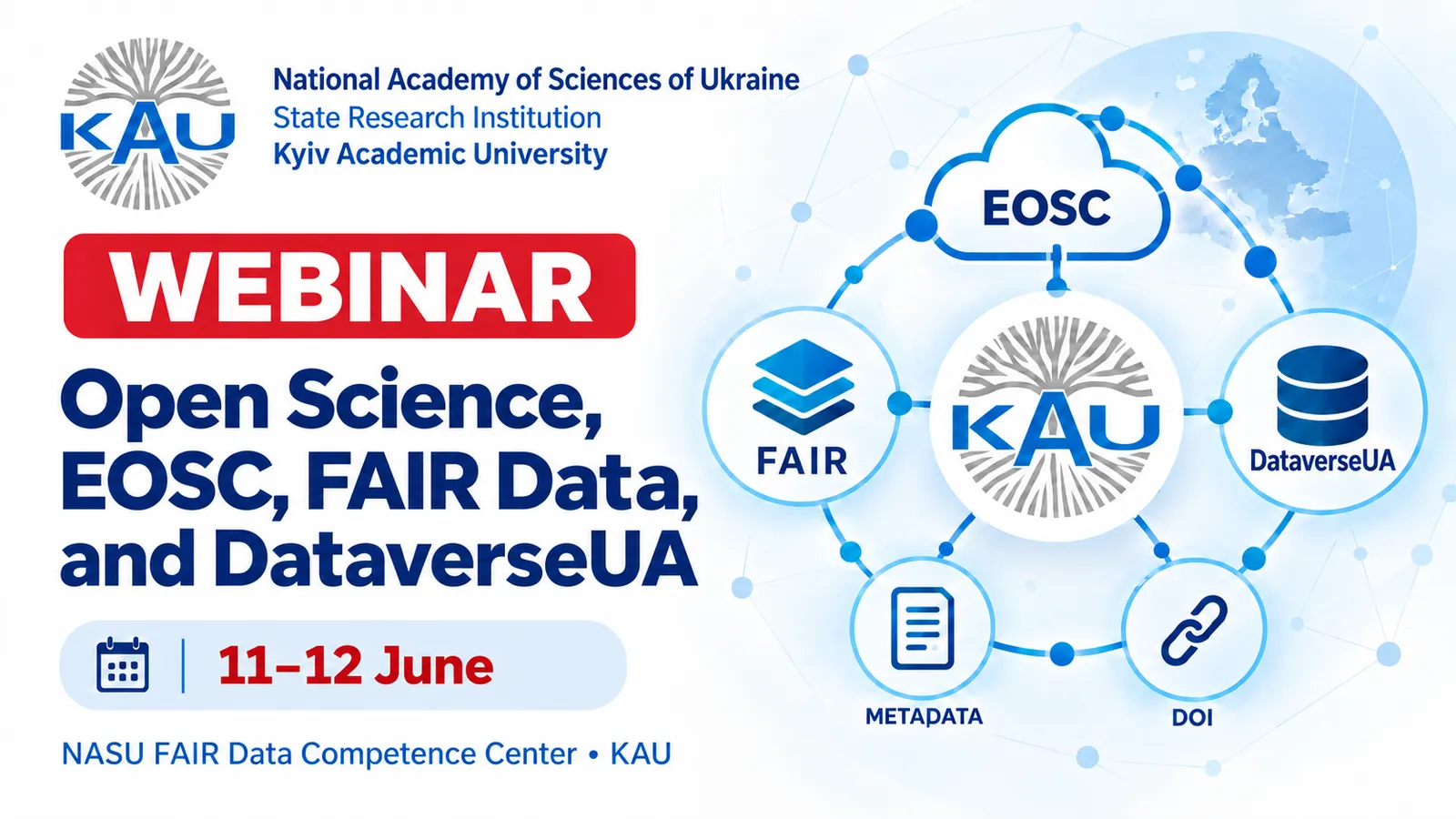
On June 11–12, 2026, the Kyiv Academic University (KAU), together with the Bogolyubov Institute for Theoretical Physics of the National Academy of Sciences of Ukraine (BITP), were held an online training webinar titled "Open Science, the European Open Science Cloud (EOSC), FAIR Data, and the DataverseUA Repository." The event is intended for researchers and PhD students from scientific institutions within the National Academy of Sciences of Ukraine.
June 11, it were feature lectures on Open Science, the current structure and objectives of the European Open Science Cloud (EOSC), and the development of the Open Science Infrastructure of the NAS of Ukraine.
June 12, program include lectures on the functionalities of the NAS of Ukraine’s open data repository, DataverseUA, as well as on FAIR data and the creation of research data management plans. Additionally, practical sessions will be held for dataset authors and data curators on using the DataverseUA repository, covering topics such as data uploading and organization; metadata and data identification; licenses and distribution terms; and data publication and dataset management.
The target audience includes PhD students, early-career scientists, and research staff from NAS of Ukraine institutions and shared-use scientific equipment centers, as well as academic and teaching staff from universities—specifically those who provide consulting support for depositing research data into the DataverseUA open data repository.
Webinar Programme
Day 1: 11 June 2026, 14:30–17:30
Webinar 1: “Open Science and the European Open Science Cloud (EOSC)”.
| 14:30–15:20 | Lecture: “Open Science.” Lidiia Hladchenko, PhD in Economics, Open Innovation Ecosystems Laboratory, KAU |
| 15:30–16:20 | Lecture “Structure and Functions of the EOSC Federation” Andrii Shevchenko, PhD in Physics and Mathematics, KAU |
| 16:30–17:20 | Lecture “Beyond Research Data: Open Science-Related Services.” Vadim Tulchinsky, Doctor of Physical and Mathematical Sciences, Oleksandr Kolomiyets, PhD in Physics and Mathematics, Ivan Denkov, V.M. Glushkov Institute of Cybernetics, NAS of Ukraine |
Lecture: “Open Science.”
Lidiia Hladchenko, PhD in Economics, Open Innovation Ecosystems Laboratory, KAU
In the video lecture “Open Science”, Lidiia Hladchenko, PhD in Economics and Associate Professor at the Laboratory of Open Innovation Ecosystems, Kyiv Academic University, explains how digital technologies are transforming the organisation of research and why openness is becoming one of the foundations of modern science. The lecture discusses the meaning and importance of Open Science and traces its development from the Budapest Open Access Initiative to the FAIR principles, the UNESCO Recommendation and the Open Science by default approach. Particular attention is paid to open publications and research data, research integrity, citizen science, new assessment models, education and digital skills. The lecturer introduces the European Open Science Cloud (EOSC), its federated model and the opportunities it provides for discovering, accessing and reusing data, tools and services. The concluding section focuses on the Ukrainian context: the National Open Science Plan, the Concept for Implementing European Open Science Principles at the National Academy of Sciences of Ukraine, and the OPENS and OPENS2 infrastructure projects. The lecture provides a foundation for further study of FAIR data and data deposition practices in DataverseUA.
Lecture “Structure and Functions of the EOSC Federation”
Andrii Shevchenko, PhD in Physics and Mathematics, KAU
In the video lecture “Structure and Functions of the European Open Science Cloud (EOSC)”, Andrii Shevchenko of Kyiv Academic University explains the transition from the general principles of Open Science to a practical understanding of EOSC as a federation of nodes, services, rules and trust. The lecture examines the drivers behind EOSC, its evolution from the European cloud concept to an operational federated model, and the main types of nodes: national, thematic and e-infrastructure nodes, together with the central EOSC EU Node. Particular attention is paid to the “system of systems” principle, participant autonomy, governance, trust, security and shared federating capabilities, including authentication and authorisation, resource catalogues, helpdesk services, monitoring and service management. Practical examples demonstrate how researchers can discover data and services, sign in through a federated identity, and use computing resources and virtual research environments. The concluding section focuses on the Ukrainian context: the existing infrastructure of the National Academy of Sciences of Ukraine, the remaining gaps on the path towards EOSC readiness, and the transition from an AAI-ready thematic pilot to a future federation of NASU EOSC Nodes.
Lecture “Beyond Research Data: Open Science-Related Services.”
Vadim Tulchinsky, Doctor of Physical and Mathematical Sciences, Oleksandr Kolomiyets, PhD in Physics and Mathematics, Ivan Denkov, V.M. Glushkov Institute of Cybernetics, NAS of Ukraine
In the video lecture “Not Only Research Data: Related Open Science Services”, Vadym Tulchynskyi, Oleksandr Kolomiiets and Ivan Denkov of the V. M. Glushkov Institute of Cybernetics of the National Academy of Sciences of Ukraine demonstrate that implementing Open Science involves much more than publishing datasets. Research integrity depends on links between a scientific publication, its underlying data, open software code, the research infrastructure used and a preprint establishing scientific priority. The lecture reviews European approaches to Open Science and presents repositories designed for different types of research outputs. A separate section examines the development of Ukrainian regulatory requirements, the concept of a trusted repository, and the differences between the infrastructure models of the Ministry of Education and Science and NASU. The speakers introduce the main components of the NASU Open Science Infrastructure: its central portal, the Competence Center, DataverseUA, the open-text repository, preprint archive, metadata harvester, journal and institutional repository platforms, shared research equipment centres and the SCIT supercomputer complex. The lecture presents Open Science as an interconnected ecosystem of data, publications, computing resources and services.
II. Day 2: June 12, 14:30 – 17:30,
Webinar 2: “DataverseUA – The Open Data Repository of the National Academy of Sciences of Ukraine: Practical Use for Authors and Data Curators.”
| 15:40–16:40 | Lecture “DataverseUA: Open Data Repository of the National Academy of Sciences of Ukraine” Serhii Svistunov, PhD in Engineering, BITP, NAS of Ukraine |
| 14:30–15:20 | Lecture “FAIR Data and Research Data Management” Lidiia Hladchenko, PhD in Economics, Open Innovation Ecosystems Laboratory, KAU |
| 16:50–17:50 | Practical Use of the DataverseUA Repository Nataliia Denysiuk, PhD in Physics and Mathematics, I.M. Frantsevich Institute for Problems of Materials Science, NAS of Ukraine, Svitlana Smoliak, PhD in Physics and Mathematics, G.V.Kurdyumov Institute for Metal Physics, NAS of Ukraine. |
Lecture “DataverseUA: Open Data Repository of the National Academy of Sciences of Ukraine”
Serhii Svistunov, PhD in Engineering, BITP, NAS of Ukraine
In the video lecture “The NASU Open Research Data Repository DataverseUA: Practical Use for Data Authors and Curators”, Serhii Svistunov and Pavlo Svirin of the Bogolyubov Institute for Theoretical Physics of the National Academy of Sciences of Ukraine explain the role of research data repositories within Open Science infrastructure. The lecture examines the purpose and principal types of repositories, criteria for selecting a reliable repository, CoreTrustSeal requirements, DOI registration through DataCite, licensing and the importance of complete metadata for data discovery and reuse. DataverseUA is presented as an outcome of the OPENS and OPENS2 projects. The speakers describe the reasons for choosing the open-source Dataverse software, the repository’s support infrastructure and its representation in international discovery systems. Particular attention is paid to the responsibilities of DataverseUA curators and institutional data curators. The complete deposit workflow is presented step by step: obtaining institutional permission, registering an account, requesting depositor rights, completing the deposit request, signing an agreement, uploading files, describing metadata, selecting a licence, curator review, DOI registration and dataset publication. The lecture provides practical guidance for researchers, curators and institutions planning to deposit data in DataverseUA.
Lecture “FAIR Data and Research Data Management”
Lidiia Hladchenko, PhD in Economics, Open Innovation Ecosystems Laboratory, KAU
In the video lecture “FAIR Data and Research Data Management”, Lidiia Hladchenko, PhD in Economics and Associate Professor at the Laboratory of Open Innovation Ecosystems, Kyiv Academic University, explains how research data should be organised so that they can be discovered, understood, combined and reused by both people and computer systems. The lecture distinguishes FAIR data from open data and examines the principles of findability, accessibility, interoperability and reusability. Particular attention is paid to persistent identifiers, metadata, repositories, access conditions, long-term preservation, Creative Commons licences, linked data and data provenance. The second part focuses on managing data throughout the research lifecycle and on the role of a Data Management Plan. It discusses the purpose of the plan, responsible participants, online planning tools and its principal components, including ethical and legal issues, data protection, storage and sharing. The lecture also presents the recommendations of the Ministry of Education and Science of Ukraine for higher education and research institutions. It provides a practical foundation for preparing research data for deposit in DataverseUA.
Practical Use of the DataverseUA Repository
Nataliia Denysiuk, PhD in Physics and Mathematics, I.M. Frantsevich Institute for Problems of Materials Science, NAS of Ukraine,
Svitlana Smoliak, PhD in Physics and Mathematics, G.V.Kurdyumov Institute for Metal Physics, NAS of Ukraine.
This practical video session introduces the main operations performed by dataset authors and data curators in the DataverseUA repository. It presents authentication through the NAS of Ukraine single sign-on system, ORCID or Google, explains the structure of institutional collections, and outlines user roles and access permissions. Participants are introduced to metadata schemes supported for different research domains, including DataCite, Dublin Core, DDI and CodeMeta. The session provides step-by-step guidance on creating a dataset: selecting a collection, completing mandatory fields, uploading and describing files, adding tags, choosing a licence and saving a draft. It also covers dataset versioning, recommended citation practices, exporting references in EndNote XML, RIS and BibTeX formats, checksums, restricted access and file-level metadata. Particular attention is given to metadata templates, guestbooks, linking datasets across collections, and the complete data lifecycle—from drafting and publication to deactivation and the release of a new version. The session provides a practical understanding of everyday work with DataverseUA.