Open Science, the European Open Science Cloud (EOSC), FAIR Data and the NAS of Ukraine Open Research Data Repository DataverseUA
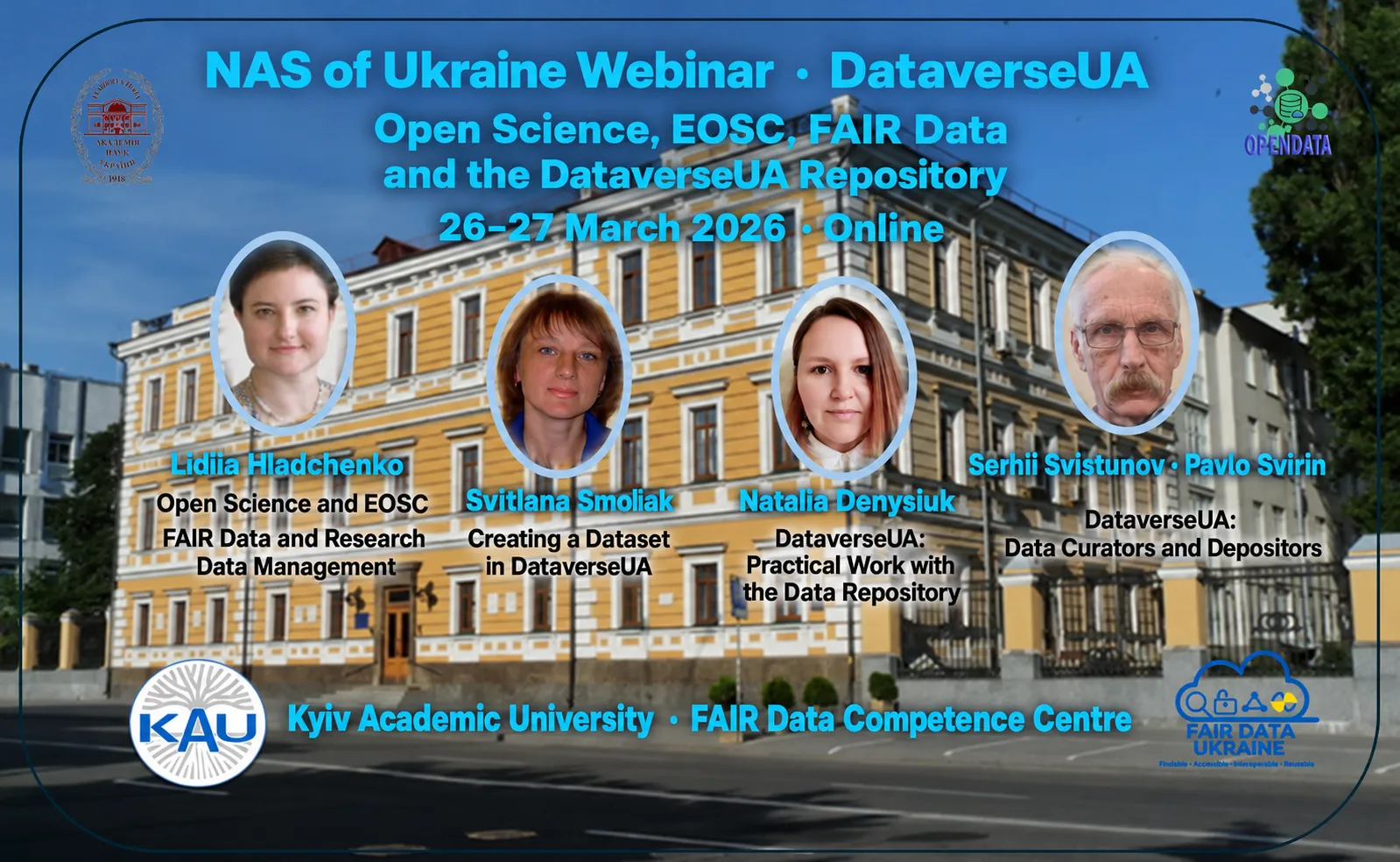
On 26–27 March 2026, Kyiv Academic University held two-day online professional development courses for researchers from institutions of the National Academy of Sciences of Ukraine.
The courses were organised in accordance with Directive No. 579 of the Presidium of the National Academy of Sciences of Ukraine, dated 24 November 2025, “On the Organisation of Advanced Training Courses for Researchers and Optional Training for Postgraduate Students of Institutions of the NAS of Ukraine.”
The programme covered Open Science, the European Open Science Cloud, FAIR data, research data management, the preparation of Data Management Plans, and the use of the DataverseUA Open Research Data Repository of the NAS of Ukraine.
The training was delivered online and combined theoretical lectures with a practice-oriented seminar. Participants who completed the full two-day programme received certificates.
Day One 26 March 2026
Open Science and the European Open Science Cloud
| 14:00–15:20 | Lecture: “Open Science and the European Open Science Cloud” Lidiia Hladchenko, PhD in Economics, Open Innovation Ecosystems Laboratory, KAU |
| 15:40–17:20 | Lecture “FAIR Data and Research Data Management” Lidiia Hladchenko, PhD in Economics, Open Innovation Ecosystems Laboratory, KAU |
Lecture: “Open Science and the European Open Science Cloud (EOSC),”
Lidiia Hladchenko, PhD in Economics, Open Innovation Ecosystems Laboratory, Kyiv Academic University.
In Part I of the video lecture “Open Science and the European Open Science Cloud (EOSC)”, Lidiia Hladchenko explains Open Science as a modern approach to organising research and shows why openness, collaboration and the reuse of research outputs have become essential for scientific progress. The lecture traces major milestones in the development of Open Science, from the Budapest Open Access Initiative and the Berlin Declaration to the FAIR principles, Plan S, the UNESCO Recommendation and Ukraine’s National Open Science Plan. It introduces the main pillars of Open Science, including open access, citizen science, research integrity and reproducibility, new approaches to assessment, education and skills. Particular attention is given to EOSC as a federated environment for discovering, publishing and reusing data, tools and services. The final section presents Ukraine’s participation in EOSC, the NAS of Ukraine Open Science Concept for 2024–2030, and the principal components of the Academy’s Open Science infrastructure.
Lecture: “FAIR Data and Research Data Management,”
Lidiia Hladchenko, PhD in Economics, Open Innovation Ecosystems Laboratory, Kyiv Academic University.
In Part II of the video lecture “FAIR Data and Research Data Management”, Lidiia Hladchenko explains how research files can be transformed into a well-described, accessible and reusable scholarly output. The four FAIR principles—Findability, Accessibility, Interoperability and Reusability—are examined together with the role of persistent identifiers, metadata, open formats, linked data and data provenance. Separate sections address access conditions, long-term preservation and Creative Commons licences. The lecture then introduces research data management across the entire data lifecycle and presents the Data Management Plan as a practical tool for both researchers and research institutions. It discusses the purpose and main components of a DMP, the distribution of responsibilities within a research team, recommendations of the Ministry of Education and Science of Ukraine, and online services including DMPonline, DMPTool, Argos and OpenAIRE. The lecture concludes with a practical workflow for preparing data and accompanying documentation for deposit in a research data repository.
Day 2 27 March 2026
The DataverseUA Repository Data Curators and Depositors
| 14:00–15:00 | Lecture “The DataverseUA Repository: Data Curators and Depositors” Serhii Svistunov, PhD in Engineering, BITP, NAS of Ukraine |
| 15:20–17:20 | Practical Use of the DataverseUA Repository for Authors and Data Curators Nataliia Denysiuk, PhD in Physics and Mathematics, I.M. Frantsevich Institute for Problems of Materials Science, NAS of Ukraine, Svitlana Smoliak, PhD in Physics and Mathematics, G.V.Kurdyumov Institute for Metal Physics, NAS of Ukraine. |
Lecture: “The DataverseUA Repository: Data Curators and Depositors”
Serhii Svistunov, PhD in Engineering, Bogolyubov Institute for Theoretical Physics of the National Academy of Sciences of Ukraine.
In the video lecture “The NAS of Ukraine Open Research Data Repository DataverseUA: Data Curators and Depositors”, Serhii Svistunov and Pavlo Svirin present the organisational workflow for depositing research data in DataverseUA. They explain the repository’s place within the EOSC-oriented Open Science infrastructure, the results of the OPENS and OPENS2 projects, and its representation in international catalogues and services. Particular attention is given to the roles of the depositor, repository data curator and institutional data curator, including their responsibilities and interaction during dataset preparation and publication. The lecture explains step by step how to register an institution, create an account, obtain the required permissions, submit a data deposit request, prepare the supporting electronic documentation and upload materials. It also covers curator review, correction of identified issues and final publication. The lecture therefore presents not only the repository interface, but the complete data support process—from a researcher’s initial request to the publication of a reviewed dataset.
Workshop: “Practical Use of the DataverseUA Repository for Authors and Data Curators”
Natalia Denysiuk, PhD in Physics and Mathematics, I. M. Frantsevich Institute for Problems of Materials Science of the National Academy of Sciences of Ukraine.
In the video lecture “DataverseUA: Data Repository”, Natalia Denysiuk introduces the main functions of the NAS of Ukraine Open Research Data Repository. The session covers authentication through the NAS of Ukraine single sign-on system, ORCID or Google, user roles and permissions, the structure of institutional collections, and collection hierarchy within the repository. It explains the use of DDI, DataCite, Dublin Core and CodeMeta standards together with domain-specific metadata schemes. The lecture demonstrates how to create a dataset, complete mandatory fields, upload files, manage versions and generate a standard data citation. Separate sections address Creative Commons licences, metadata templates, guestbooks, linking datasets across collections, and the dataset lifecycle from draft to publication and subsequent versions. Examples of international repositories are provided as reference points for preparing metadata and README files. The lecture gives dataset authors and curators an integrated practical view of everyday work in DataverseUA.
Svitlana Smoliak, PhD in Physics and Mathematics, G. V. Kurdyumov Institute for Metal Physics of the National Academy of Sciences of Ukraine;
In the practical video presentation “Creating a Dataset”, Svitlana Smoliak demonstrates how a real research dataset is prepared for deposit in DataverseUA. The workflow begins with obtaining the necessary author permissions and selecting the files to be included in accordance with the FAIR principles. It then shows how to prepare descriptive information, create meaningful metadata, choose appropriate keywords and use controlled vocabularies for the accurate description of experimental data. A separate section presents the procedure for completing the agreement governing the use and deposit of research data. Considerable attention is given to assessing the quality of the future publication with FAIR-Checker, F-UJI, the ARDC FAIR Data Self-assessment Tool and DANS FAIRdat. These services help identify weaknesses and improve compliance with the FAIR principles. The presentation concludes with assessment results and an example of a dataset published in DataverseUA with a persistent DOI. It demonstrates the complete pathway from a researcher’s local files to an accessible and reusable scholarly output.
The courses introduced participants to the principles and infrastructure of Open Science and provided practical guidance on research data management and the publication of datasets in DataverseUA. The programme connected European approaches to FAIR data and EOSC with the development and practical use of research data infrastructure within the National Academy of Sciences of Ukraine.