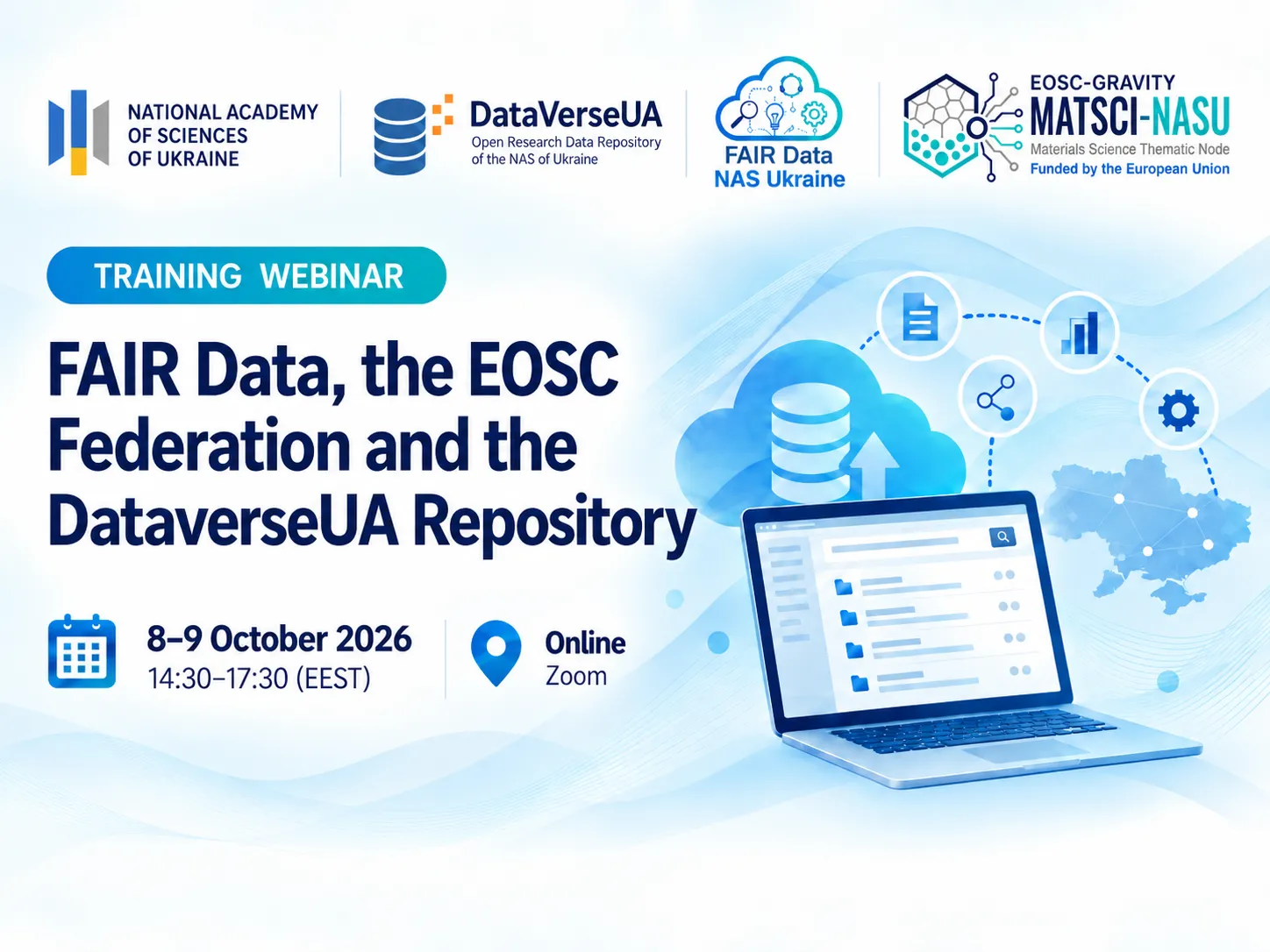
MATSCI-NASU Training Webinar "FAIR Data, the EOSC Federation and the DataverseUA Repository"
As part of the MATSCI-NASU project under the EOSC Gravity programme, the Kyiv Academic University (KAU), together with the Bogolyubov Institute for Theoretical Physics of the National Academy of Sciences of Ukraine (BITP), holded an online training webinar on 8–9 October 2026 for researchers and PhD students from research institutions of the National Academy of Sciences of Ukraine.
Target audience. The webinar is intended for PhD students, early-career researchers and research staff of institutions of the National Academy of Sciences of Ukraine, staff of Shared Research Facilities, and university academic and research staff, including specialists who provide advisory support for depositing research data in DataverseUA
Webinar Programme
Day 1: 8 October 2026, 14:30–18:30
Webinar 1: FAIR Principles, the EOSC Federation
14:30–14:35
Welcome address, Serhii Svistunov, PhD in Engineering, BITP, MATSCI-NASU Project Coordinator within the EOSC Gravity programme
14:40–15:40 Questions
15:40–15:50
Lecture “From RDM Training to Practice: Unlocking the Potential of the EOSC Federation. Insights from EOSC Node Poland”
Natalia Galica, the Open Science Office at the National Science Centre (NCN), Poland.15:50–16:50 Questions
16:50–17:00Lecture “FAIR Principles, FAIR Data and Research Data Management”
Lidiia Hladchenko, PhD in Economics, Open Innovation Ecosystems Laboratory, KAU17:00–18:20 Questions
18:20–18:30Lecture “Structure and Functions of the EOSC Federation”
Andrii Shevchenko, PhD in Physics and Mathematics, KAU
Day 2: 9 October 2026, 14:30–18:00
Webinar 2: Open Research Data Repository of the NAS of Ukraine (DataverseUA) — Practical Use for Dataset Authors and Data Curators
14:30–15:30
Questions 15:30–15:40
- Lecture "Institutional Repository Platform of the NAS of Ukraine"
Vadim Tulchinsky, Doctor of Physical and Mathematical Sciences, Vyacheslav Roganov, PhD in Physics and Mathematics, V.M. Glushkov Institute of Cybernetics, NAS of Ukraine - Lecture "Archive of Preprints of the NAS of Ukraine"
Vadim Tulchinsky, Doctor of Physical and Mathematical Sciences, Oleksandr Kolomiyets, PhD in Physics and Mathematics, Ivan Denkov, V.M. Glushkov Institute of Cybernetics, NAS of Ukraine
15:40–16:40
Questions 16:40–16:50 Lecture "Open Research Data Repository of the NAS of Ukraine (DataverseUA)"
Serhii Svistunov, PhD in Engineering, BITP, NAS of Ukraine16:50–17:50
Questions 17:50–18:00Practical session “Practical Use of the DataverseUA Repository for Dataset Authors and Data Curators”
Nataliia Denysiuk, PhD in Physics and Mathematics, I.M. Frantsevich Institute for Problems of Materials Science, NAS of Ukraine, Svitlana Smoliak, PhD in Physics and Mathematics, G.V.Kurdyumov Institute for Metal Physics, NAS of Ukraine.
At the beginning of the meeting, there will be a lecture by guest speaker Natalia Galica, (the Open Science Office at the National Science Centre (NCN), Poland) about the potential opportunities of the EOSC Federation for Ukrainian researchers and about the EOSC Node Poland.
In this lecture, Lidiia Hladchenko provides a practical introduction to FAIR data and research data management. It explains how FAIR data differ from data that are merely open and how Findability, Accessibility, Interoperability and Reusability are applied in practice. The lecture covers persistent identifiers, metadata, repositories, licences, machine-readable formats, vocabularies, linked data and provenance. It also distinguishes a FAIR dataset from a FAIR workflow: the former ensures that a research output is properly described and accessible, while the latter supports reproducibility of the sequence of actions, software environment and links between input and output data. The second part examines the research data lifecycle and the purpose of a Data Management Plan. Its components include data creation and description, ethical and legal issues, storage and backup, access, publication, long-term preservation, roles and costs. The lecture also introduces widely used DMP tools and outlines the recommendations of the Ministry of Education and Science of Ukraine.