Data Stewardship – Module 1: MOOC
In this section, you will learn about why research data management (RDM) is important for science and society, and why good research data management is beneficial to you as a junior researcher. You will also get an introduction to some basic RDM concepts that are essential in order to fully benefit from the remainder of this course.
After working through this section, you should be able to:
Have an understanding of the background and rationale of good research data management (RDM), and its connection to transparency, reproducibility and reuse of science.
- Explain why open archiving is put forth as the preferred option, and why in some cases it is not possible.
- Explain potential advantages of and barriers to data sharing.
- Understand requirements on data accessibility issued by relevant funders, institutions, and journals.
- Be familiar with the research data management life cycle.
- Describe the FAIR principles.
1.1 The importance of research data management
Why should we care about the practices we employ when handling our research data? Why should we invest the time that handling research data requires? In this video, you will meet Kenneth Ruud, Professor of Theoretical and Computational Chemistry and former Vice Chancellor of Research at UiT The Arctic University of Norway. Being an experienced researcher with a profound interest in open science, he reflects on the importance of research data for science and why transparency of research data management practices is key.
Lessons learned
- Transparency of research implies sharing information about the data and the methods used to collect or generate them, programs used to analyse them, and if and how other people can access them.
- As a reader of research articles, by having access to the data material and the code used in the analyses, you can reproduce research and see whether you reach the same conclusions as the original authors.
- There is currently a huge shift internationally in terms of openness with regard to research data.
- Science may become more effective with a culture of data sharing, as the same data can be used for different purposes.
- Research data should be in a format that can be used by different computer architectures. We don’t know what may be possible in the future. You should therefore think broadly about what constitutes your data and make them available.
- Investing in developing high quality datasets may improve your scientific standing and the impact of your PhD work.
- Institutions that have signed the DORA declaration are committed to evaluating all your contributions to science, not only your research articles.
1.2 Transparency and openness: Requirements and expectations
Why do funders and institutions require that we write data management plans and that we archive our research data with open access? Why do scientific journals require, or at least expect, that we inform peer reviewers and readers of our research papers not only about how to access our data, but also about the methodology we have used when collecting and analysing them? In this video, you will learn the rationale behind these expectations and requirements.
Lessons learned
- Transparency is a prerequisite for the reproducibility and replicability of our research.
- All research can be transparent, but not all research can be fully open – e.g. if data hold sensitive information.
- Scientific journals, funders, institutions, national governments and non-profit organisations work together to promote a more healthy research and publication system.
- It is your responsibility as a member of the scholarly community to acquire the competencies and skills necessary to work in line with good research practices.
Food for thought
Check out which requirements and expectations that apply to your PhD work with respect to research data. Be well prepared and check whether your institutional PhD regulations say anything about research data, and whether your institution has issued a policy stating how employees should proceed in their research data management. If you have external funding of your project, check what your funder's requirements are on this matter.
Also check the author guidelines of 2–3 journals within your field, to see what they require from you when you submit a research paper manuscript.
1.3 The research data management life cycle
Research data management is an integral part of the research process, and there are in fact data-related aspects to think about from the very beginning to the end, from when you start planning your project to when you publish your research. In this video, you will get an introduction to the so-called life cycle of research data management, which contains all the topics that you will learn about later in this online course.
Lessons learned
- The research data management life cycle contains all data-related steps during a research project.
- The planning phase includes searching for existing data and writing a data management plan.
- In the active phase, you collect, store, organise, document, and visualise your data, and do your analyses and interpretations of the results.
- In the final phase, you archive your data in a suitable data repository, as open as possible and as closed as necessary, and cite them in your research paper.
Last modified: Tuesday, 20 December 2022, 2:30 PM
1.4 The FAIR data principles
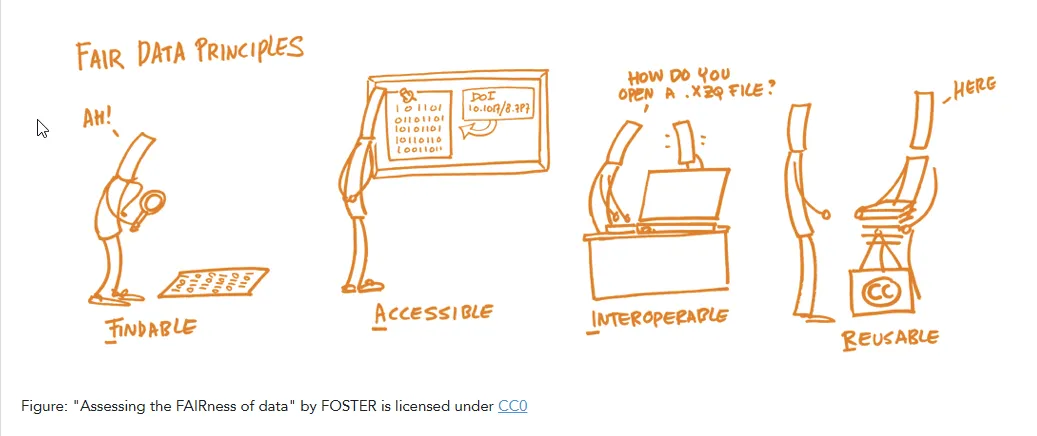
In the interview with Kenneth Ruud, there was mention of the term FAIR principles. These principles were drafted in 2014 during an international meeting and published in 2016 by Wilkinson and colleagues. The FAIR principles are a set of guidelines developed to optimise the reusability of research data, and they form the basis for the good research data management practices introduced in this online course. Learn more about what is behind the acronym FAIR in the following video:
Lessons learned
- Findable: The first step in (re)using data is to find them. Metadata and data should be easy to find for both humans and computers.
- Accessible: Finding a dataset does not automatically mean access to the data. The reference must be persistent, and the data files must be accessible.
- Interoperable: The repository must be machine harvestable, and metadata must follow standards, to allow data to be combined with data from other repositories. Repositories need to interoperate with software or workflows for storage, processing, and analysis.
- Reusable: The ultimate goal of FAIR is to optimise the reuse and control of data and to ensure transparency. To achieve this, metadata and data should be well documented so that the analysis can be reproduced and/or data be reused in other ways.
- CESSDA Training Team. (2017 – 2022). CESSDA Data Management Expert Guide. CESSDA ERIC. https://dmeg.cessda.eu/
- Deutz, D. B., Buss, M. C. H., Hansen, J. S., Hansen, K. K., Kjelmann, K. G., Larsen, A. V., Vlachos, E., & Holmstrand, K. F. (2020). How to FAIR: A Danish website to guide researchers on making research data more FAIR. https://doi.org/10.5281/zenodo.3712065
- OpenAIRE (n.d.). How to make your data FAIR? https://www.openaire.eu/how-to-make-your-data-fair
- Wilkinson, M. D., Dumontier, M., Aalbersberg, I. J., Appleton, G., Axton, M., Baak, A., Blomberg, N., Boiten, J.-W., da Silva Santos, L. B., Bourne, P. E., Bouwman, J., Brookes, A. J., Clark, T., Crosas, M., Dillo, I., Dumon, O., Edmunds, S., Evelo, C. T., Finkers, R., ... & Mons, B. (2016). The FAIR Guiding Principles for scientific data management and stewardship. Scientific Data, 3, Article 160018. https://doi.org/10.1038/sdata.2016.18
Last modified: Wednesday, 8 January 2025, 7:51 AM
1.6 The Data Management Plan
Good data management requires good planning. Data management involves several steps, from focusing and limiting the scope of data collection to deciding on collection methods and how to keep your data safe, and how to analyse and archive your data. And more. All these steps need to be planned well. That is what you do when you are spending time on developing your data management plan.
Note: This is an introduction to the Data Management Plan (DMP). The topic of DMPs is more comprehensively covered in Section 9: "How to write a Data Management Plan"
In the following video you'll get som practical advice on how to create a Data Management Plan.
Lessons learned
- The data management plan (DMP) serves as a guiding framework and may be useful throughout your PhD project, and help you avoid common pitfalls.
- Remember to update your DMP as you move forward and gain new knowledge on the steps involved in your project.
- In your DMP you should normally include, among other elements:
- information on resource requirements
- responsibilities (within the project team)
- methods you plan to use
- storage and backup plans
- if applicable, how to collect the necessary consent for how you will use the data.
Food for thought
Think about your own PhD project and the tasks you have ahead of you. Now imagine that you are informed that your funding is cut back significantly. How would you handle this challenge? How can you carry through your project with (significantly) less funding? Hint: Go through your DMP and try to identify elements where savings can be made.
Last modified: Sunday, 21 January 2024, 6:44 PM