MODEL_CARD Template for MLIP
This template is intended for documenting machine-learning interatomic potentials (MLIPs) as part of a reproducible computational research workflow.
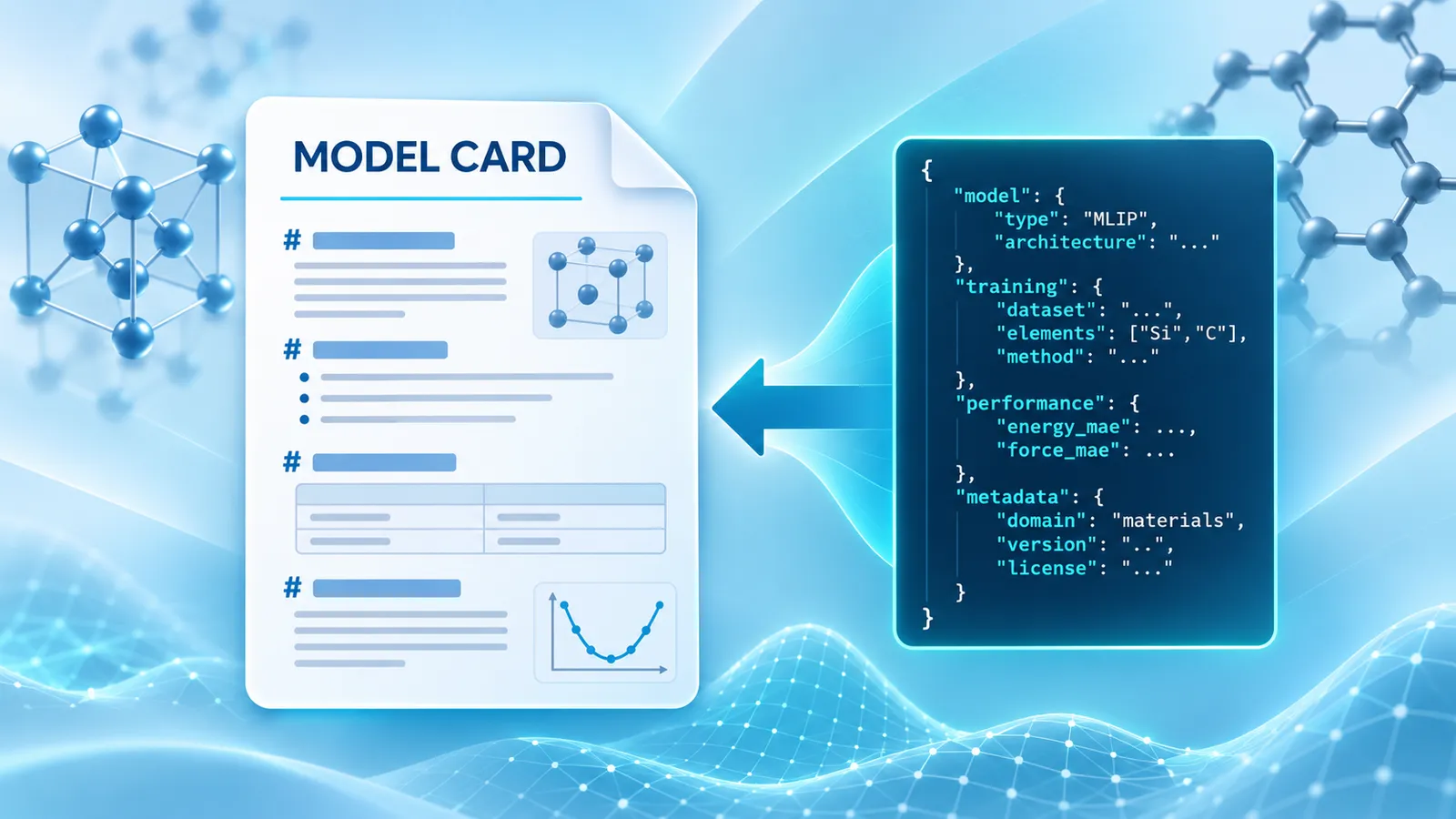
A MODEL_CARD.md provides a concise human-readable description
of model identification, intended use, training data, major hyperparameters,
evaluation results, applicability limits, model artefacts, and known limitations.
Within the MATSCI-NASU profile, the model card is generated from structured metadata rather than maintained as an independent source of information. This reduces duplication and helps keep the human-readable description consistent with machine-readable metadata.
How it works
MLIP metadata
Dataset metadata
Generator
Human-readable model description
Human-readable materials
Resources intended for researchers, data stewards, reviewers, and users of the model.
MODEL_CARD Template
Reusable Markdown template showing the structure of
MODEL_CARD.md and the metadata fields from which
the values are generated.
MODEL_CARD Example
Example of a completed model card showing how structured MLIP and dataset metadata are presented to a human reader.
Machine-readable resources
Structured metadata and validation resources used to generate and verify the MODEL_CARD.
MLIP Metadata Example
Example mlip.json record containing model identity,
training setup, model parameters, evaluation results,
model artefacts, and limitations.
MLIP JSON Schema
JSON Schema defining the machine-readable structure and validation rules for the MLIP metadata record.
Single source of truth
The MODEL_CARD should not be maintained independently from the structured
metadata. The authoritative information is stored in
mlip.json and dataset.json.
When model metadata change, update the structured records and regenerate
MODEL_CARD.md.
MODEL_CARD Template
The preview below shows the structure of the reusable
MODEL_CARD.md template.
View MODEL_CARD Template
# Model card: <modelIdentity.name>

<modelIdentity.identifier>

Version: <modelIdentity.version>

Release date: <modelIdentity.releaseDate>


## 1. Overview

<description>

Potential type:
<potentialCreated.potentialType>

Elements:
<potentialCreated.elements>


## 2. Identification, licence and citation

Model identifier:
<modelIdentity.identifier>

Model version:
<modelIdentity.version>

Model file:
<modelArtifacts.path>

SHA-256:
<modelArtifacts.checksumSHA256>

Licence:
<modelIdentity.license>

Dataset:
<dataset.title>

Dataset PID:
<dataset.identifier.value>


## 3. Intended use and limits of use

Primary use:
<intendedUse.primaryUse>

Suitable for:
<intendedUse.suitableFor[]>

Not recommended for:
<intendedUse.outOfScope[]>


## 4. Model and hyperparameters

Potential type:
<potentialCreated.potentialType>

Descriptor:
<potentialCreated.descriptorType>

Cutoff radius:
<potentialCreated.cutoffRadius>


## 5. Training data

Number of structures:
<trainingDataset.numberOfStructures>

Reference level of theory:
<trainingDataset.referenceLevel>

Train / validation / test split:
<trainingSetup.trainValTestSplit>


## 6. Training setup

<trainingSetup>


## 7. Evaluation metrics

<resultsSummary.metrics>


## 8. Model selection

<modelSelection>


## 9. Applicability domain

<resultsSummary.applicabilityDomain>


## 10. Validation

<resultsSummary.validation>


## 11. Model artefacts

<modelArtifacts>


## 12. Known limitations

<resultsSummary.knownLimitations[]>


## 13. How to use the model file

Model file:
<modelArtifacts.path>

Format:
<modelArtifacts.format>

Compatible interfaces:
<modelArtifacts.interfaces>


## 14. Related calculations

<relatedCalculations[]>


## What this card is missing

Automatically generated list of incomplete sections
and metadata fields that should be completed.
MODEL_CARD Example
The example demonstrates how structured MLIP and dataset metadata can be transformed into a human-readable model description.
View completed MODEL_CARD
The full example can be inserted here as rendered Markdown content. The downloadable source file is provided below.
The example is intended to illustrate the MODEL_CARD structure. It should not be interpreted as a complete reference model for every MLIP workflow.
MLIP Metadata Example
A shortened fragment of the machine-readable MLIP metadata record is shown below. The complete example is available as a JSON file.
View MLIP metadata example
{
  "modelIdentity": {
    "name": "Example MLIP model",
    "version": "1.0"
  },

  "potentialCreated": {
    "potentialType": "MLIP",
    "elements": [
      "Si",
      "C"
    ]
  },

  "trainingDataset": {
    "datasetRef": "dataset.json"
  },

  "modelArtifacts": {
    "path": "mlip/model/example.model",
    "checksumSHA256": "..."
  },

  "resultsSummary": {
    "knownLimitations": []
  }
}
MLIP JSON Schema
The schema defines the permitted structure, data types, controlled values, and required elements of an MLIP metadata record.
View schema fragment
{
  "$schema": "https://json-schema.org/draft/2020-12/schema",

  "type": "object",

  "properties": {

    "modelIdentity": {
      "type": "object"
    },

    "potentialCreated": {
      "type": "object"
    },

    "trainingDataset": {
      "type": "object"
    },

    "modelArtifacts": {
      "type": "object"
    },

    "resultsSummary": {
      "type": "object"
    }

  }
}
MODEL_CARD Generator
The current MATSCI-NASU implementation generates
MODEL_CARD.md automatically from
mlip.json and dataset.json.
python3 make_model_card.py \
  mlip/mlip.json \
  -d dataset.json \
  -l en \
  -s mlip_schema.json \
  -o mlip/MODEL_CARD.md
The generator and the current metadata schemas are maintained together with the MATSCI-NASU research package.
Author Guidelines
Guidance on preparing MLIP metadata, documenting training data, model parameters, evaluation metrics, model artefacts, applicability limits, and known limitations.
MATSCI-NASU Research Package
Current metadata schemas, example records, generators, workflow, provenance, manifest, and supporting materials are maintained in DataverseUA.
Status: MATSCI-NASU working profile / reusable training resource.
Intended use: MLIP documentation · reproducible computational workflows · FAIR research objects.