Registration of EOSC Research Product Catalogues in the EOSC EU Node
29.12.2025
https://zenodo.org/records/17513272
Summary of the Document on the Registration of Research Product Catalogues in the EOSC EU Node
Technical Note version 3.1, published on 3 November 2025, describes the procedure and requirements according to which catalogues of research products — repositories and metadata aggregators — are connected to the EOSC EU Node Resource Catalogue. This enables records about publications, datasets and software to become visible in the European portal and available for search and machine harvesting.
What exactly is registered and why it matters
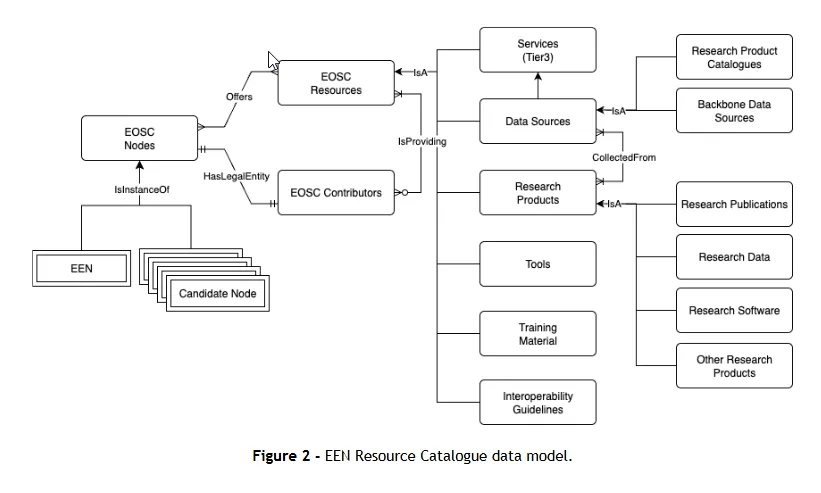
It is not an individual file or a single article that is registered, but a metadata source: a repository or aggregator that systematically publishes records about research products and enables the automatic harvesting of these records.
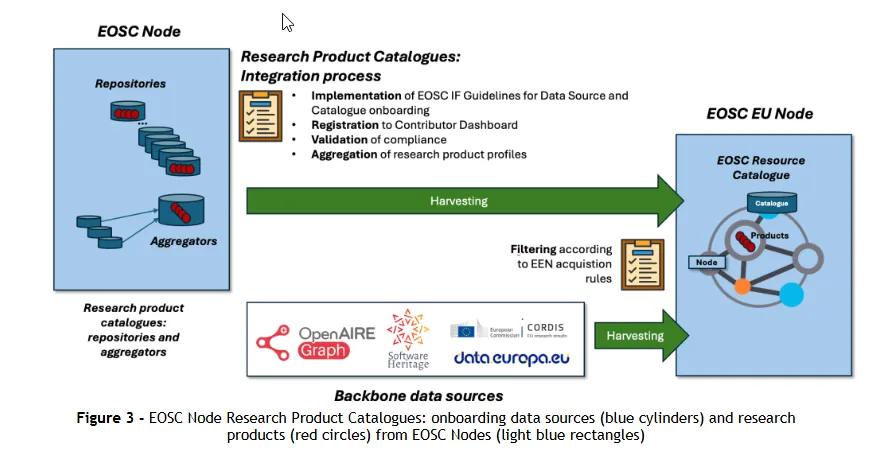
This means that, for an institution, the key result is not a one-time upload, but a stable interoperability configuration. After this is implemented, new records appear in the European catalogue as they are published in the national repository or national aggregator.
The document specifically distinguishes between two classes of sources:
- repositories, which are the primary source of metadata and objects, including data, publications and software;
- aggregators, which collect metadata from multiple repositories and republish them as a harmonised stream of records.
For aggregators, the document defines an additional obligation: to ensure transparency regarding the provenance of records.
Basic technical requirements for a catalogue as a metadata source
A critical requirement of the document is that every metadata source applying for connection must implement the Open Archives Initiative Protocol for Metadata Harvesting version 2.0 as the main mechanism for metadata access.
In practice, this means that the source must have a stable web address for access to this protocol, support batch delivery of records, typically 100–500 records per batch, and correctly handle the resumptionToken mechanism so that the European harvester can reliably process the entire set of records, even for large repositories.
A separate requirement concerns the export format. The source must provide records using the metadataPrefix parameter that points to the oai_openaire profile. This is a key point of compatibility, enabling the European infrastructure to interpret metadata consistently across different platforms.
Requirements for the metadata profile and minimum record quality
The document establishes the use of a profile that combines the DataCite approach with OpenAIRE guidelines and divides fields into mandatory, mandatory if applicable, recommended and optional categories.
For the practical preparation of a repository, this is important because validation during onboarding will check not only the existence of the protocol, but also the structure and content of the metadata.
The document defines minimum criteria without which records should not enter the European catalogue. For all product types, at least one persistent identifier from a defined list is required. These include, in particular, a digital object identifier, Handle identifier, arXiv identifier, PubMed identifier, Software Heritage identifier, as well as identifiers from domain-specific databases such as PDB, ENA and UniProt.
The document then defines the minimum fields by product type:
- for publications, the mandatory fields are title, authors, description or abstract, and publication date;
- for data, the mandatory fields are title, authors and publication date;
- for software, the mandatory fields are title and publication date.
In addition, the use of controlled vocabularies is required for the resource type and access rights, together with standardised language codes based on international standards.
This means that the repository must either already have these fields and vocabularies or must provide a mechanism for their automatic completion during export.
Additional requirements for aggregators: provenance of records and prevention of “loss of source”
For aggregators, the document requires that information about the provenance of a record be included in the about/provenance section in accordance with the recommendations of the Open Archives Initiative Protocol for Metadata Harvesting.
The practical meaning of this requirement is that the European catalogue must preserve the link between each record and the original repository. This prevents the creation of “anonymous” copies of metadata and makes it possible to trace the source, access policies and responsible record owner.
Registration and validation process: what is actually checked
The procedure requires the Node operator to register both the Node itself and each metadata source through the provider dashboard. After this, technical and structural validation of the protocol and metadata is performed. If errors are detected, the catalogue team returns comments, and the source undergoes repeated checks until the inconsistencies are resolved.
During the registration of a metadata source, not only technical information is provided, but also a set of governance attributes. These include a helpdesk contact, a security contact, links to the terms of use, privacy policy, acceptable use policy and user access policy.
Links to the submission policy and long-term preservation policy are also required. For repository identification, it is also desirable to have a record in international registries of repositories and standards.
What this directly means for the National Academy of Sciences of Ukraine
The document effectively defines the minimum “technical and organisational threshold” for connecting repositories of the National Academy of Sciences of Ukraine, including DataverseUA and the national metadata harvester, to the European catalogue.
Three groups of work are critical:
Preparation of metadata export: implementation of the Open Archives Initiative Protocol for Metadata Harvesting version 2.0, support for the oai_openaire profile, controlled vocabularies, persistent identifiers and minimum required fields for each record.
Preparation of policies and contacts: availability of pages describing access rules, preservation rules and submission rules, as well as clearly defined roles of responsible persons, including the Node coordinator, metadata source administrator, helpdesk contact and security contact.
Registration readiness of the source: preferably, repositories should be present in international registries and be ready to undergo formal verification and correct technical errors identified during validation.
Overall, the document is useful because it transforms the general idea of “connecting to the European Open Science Cloud” into a list of specific, verifiable conditions. These conditions can be used as a technical assignment for repository administrators and as a work plan for the Node operator.