NOMAD–Galaxy: A Practical Demonstrator of Research Infrastructure Interoperability in the EOSC Federation
27.11.2026
At the EOSC Symposium held in Florence on 14–16 October 2026, FAIRmat presented an initial interoperability demonstrator for EOSC Node Germany. It connects NOMAD, a research data platform rooted in materials science, with Galaxy, a platform for scientific data processing and analysis. The announcement was published on 22 October [1].
The demonstrator addresses a central question for the European Open Science Cloud (EOSC): how can independently operated data infrastructures and scientific services participate in a single research process? Two complementary examples show how published microscopy data can be made more interoperable and how spectroscopy data can be analysed remotely, with the results returned to their original data environment.
1. From data availability to service interoperability
Search catalogues, persistent identifiers and repositories enable researchers to locate and retrieve published datasets. Using those datasets across different research environments requires additional capabilities: consistent data representation, programmatic access, remote execution, and documentation of the relationship between input data, operations and results.
The NOMAD–Galaxy demonstrator explores two complementary forms of interoperability. The first concerns the preparation of published scanning tunnelling microscopy (STM) data for domain-specific reuse. The second concerns the execution of a scientific analysis on X-ray photoelectron spectroscopy (XPS) data. Together they illustrate how a shared research process can combine separate services while preserving their specialisation.
2. Participating infrastructures and their roles
Zenodo is a general-purpose repository operated by CERN in the OpenAIRE context. It provides access to research outputs and persistent digital object identifiers (DOIs).
NOMAD is an open-source research data management platform developed by FAIRmat. It represents data as searchable, structured entries, supports electronic laboratory notebooks and extracts scientific information from supported file formats. NOMAD Central and institutional NOMAD Oasis installations use a common software foundation.
Galaxy is an open-source environment for executing scientific tools and workflows. Originally developed for bioinformatics, it now supports multiple disciplines. The European Galaxy server is available at https://usegalaxy.eu/.
In the demonstrator, repositories and analysis services exchange information through application programming interfaces (APIs). The roles of the platforms are complementary: Zenodo provides access to published objects, Galaxy executes processing, and NOMAD represents materials-science data for discovery and reuse.
3. Scenario 1: from open to interoperable data
Open publication makes a dataset accessible under its stated conditions. Scientific comparison may still require harmonisation of instrument formats, metadata and units. The first scenario addresses this problem using STM data.
The NFDI use-case description [2] presents a weekly pipeline that selects new public datasets in Zenodo, uses Galaxy for conversion to NeXus and publishes the resulting structured data in NOMAD. The original Zenodo DOI is retained as a reference. The pipeline is designed to avoid processing the same file again and to use only CC0 or CC BY material with attribution.
NeXus provides conventions for organising scientific data and metadata in HDF5 files. The pynxtools-spm component supports conversion of scanning probe microscopy data. The degree of harmonisation depends on the information available in the source files and the conversion mapping. A structured representation improves the prospects for scientific search and comparison; it cannot recover experimental metadata that were never recorded.
This pattern can be understood as a further stage of FAIR preparation of published data. It adds a domain-specific representation while retaining the source identifier and respecting reuse conditions. The public description establishes the design of the weekly workflow; it does not by itself provide an independent audit of continuous production operation.
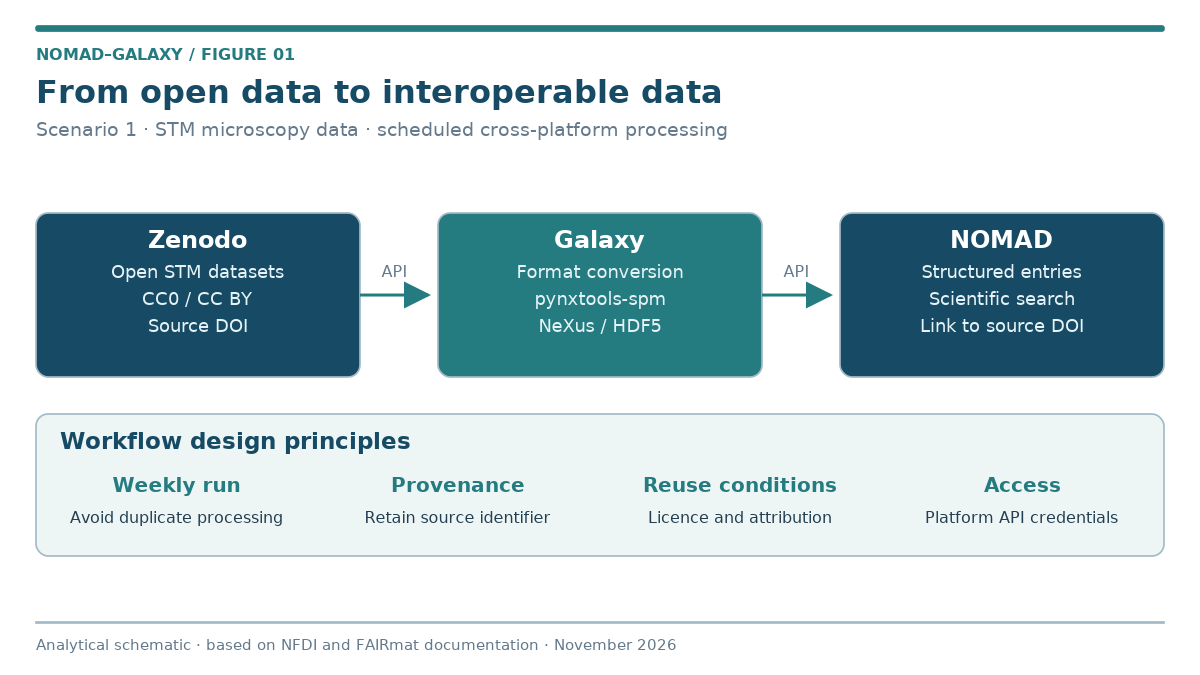
Author’s analytical schematic based on NFDI.
4. Two orchestration models for the distributed workflow
The first scenario is described in two deployment arrangements [2]. In a NOMAD-led arrangement, an institution’s Oasis installation starts the scheduled process and handles publication; Galaxy carries out the computational tasks. This arrangement can keep orchestration and institutional credentials under local control.
In a Galaxy-led arrangement, a script on an ordinary computer invokes a prepared Galaxy workflow, which publishes the output to NOMAD Central. Researchers need access to the two services but do not need to operate their own Oasis installation.
The difference is the location of workflow coordination, not the scientific objective. The two arrangements illustrate how federated infrastructures can accommodate organisations with different technical capacity. A data provider need not deploy the entire analysis environment, and an analysis service can be reused by several data environments.
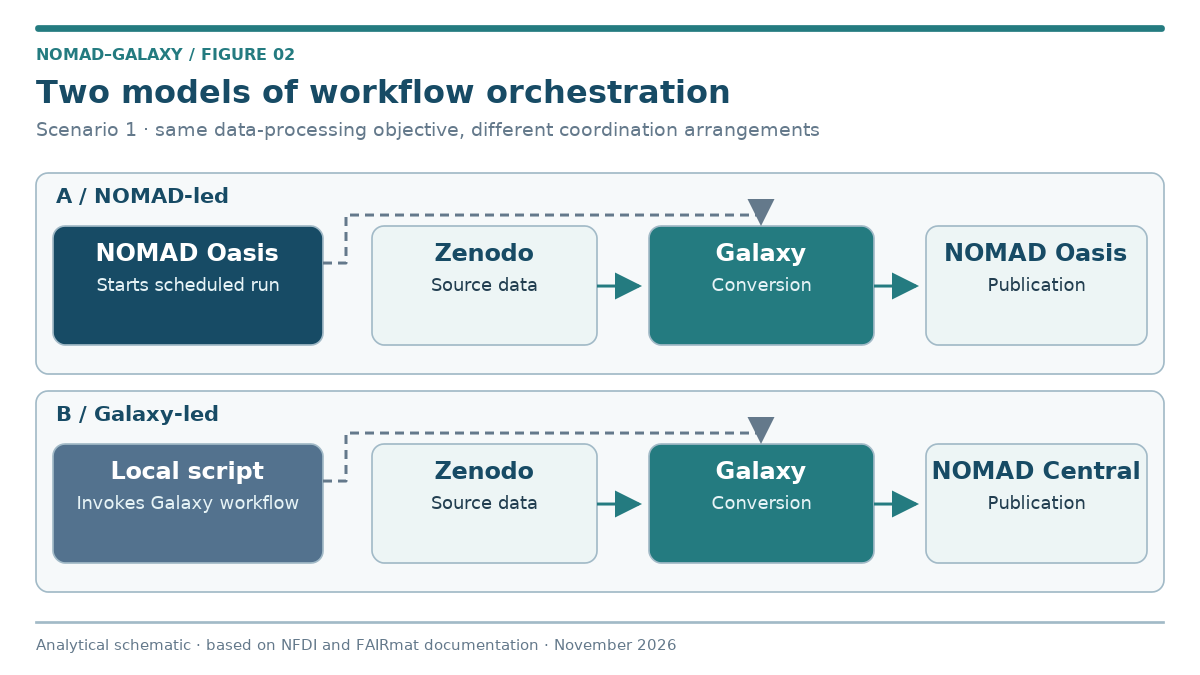
Author’s analytical schematic based on NFDI.
5. Scenario 2: analysis of XPS data and return of results
X-ray photoelectron spectroscopy (XPS) is used to investigate elemental composition and chemical states at material surfaces. Locating spectral peaks is one step in interpreting a measured spectrum. The demonstrator uses an XPS spectrum represented in NeXus (NXxps) as its input.
The researcher selects the relevant entry and launches the find_peaks Action through NOMAD. The Action retrieves the NeXus file, submits it to Galaxy, starts a peak-finding workflow, monitors the invocation and retrieves the annotated output. NOMAD then creates a new entry in the same upload/project and links it to the source spectrum [3, 4, 5].
The Galaxy tool is based on pynxtools-xps. The returned NeXus file contains the spectrum with additional peak information represented through NXfit and NXpeak. The tool also produces tabular and JSON outputs. The current Action retrieves the annotated NeXus result; the existence of the other outputs in Galaxy should not be interpreted as automatic ingestion of every output into NOMAD.
Peak detection illustrates a computational operation performed outside the data platform. Its results can be inspected alongside the initial data, while their physical interpretation and the assessment of peak-finding parameters remain scientific tasks.
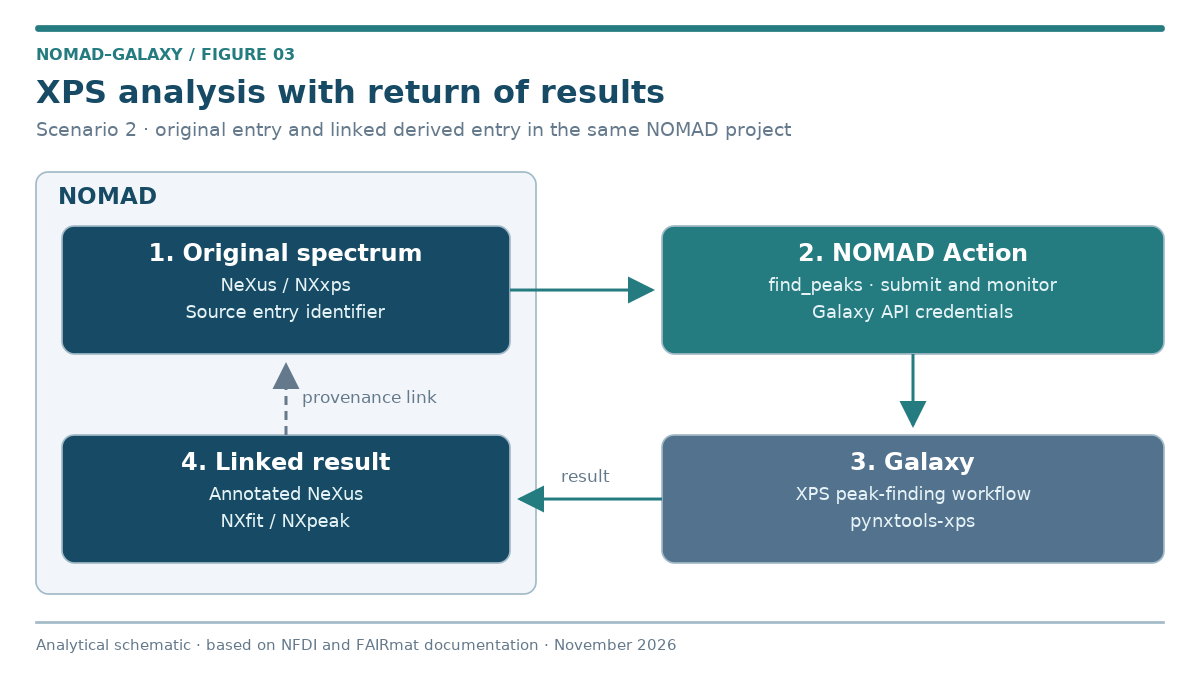
Author’s analytical schematic based on FAIRmat / NOMAD.
6. Software architecture and interface contract
The open-source plugin nomad-eosc-galaxy-actions implements the XPS round trip. NOMAD Actions supports asynchronous operations, using Temporal for durable execution. The Python library BioBlend provides programmatic access to the Galaxy REST API. Galaxy schedules the actual scientific processing on its compute backend.
The plugin is deliberately modular: the external workflow is invoked as a workflow rather than as a single tool. This provides a route towards multi-step analysis without transferring all orchestration to the data platform. Nevertheless, the current implementation relies on a particular workflow layout and output names. The technical documentation identifies the output_nxs output and the input/tool step indices as interface assumptions [4]. Changes to them may require adjustments to the plugin.
A reusable integration therefore needs a documented input/output contract, a stable invocation mechanism, controlled credential handling and a defined procedure for reporting failure or returning results.
| Component | Role |
|---|---|
| NOMAD | Data management and linked entries |
| NOMAD Actions | Asynchronous operation |
| Temporal | Durable execution |
| BioBlend | Galaxy REST API client |
| Galaxy workflow | Analysis and execution history |
| pynxtools-xps | XPS peak finding |
| NeXus | Structured data format |
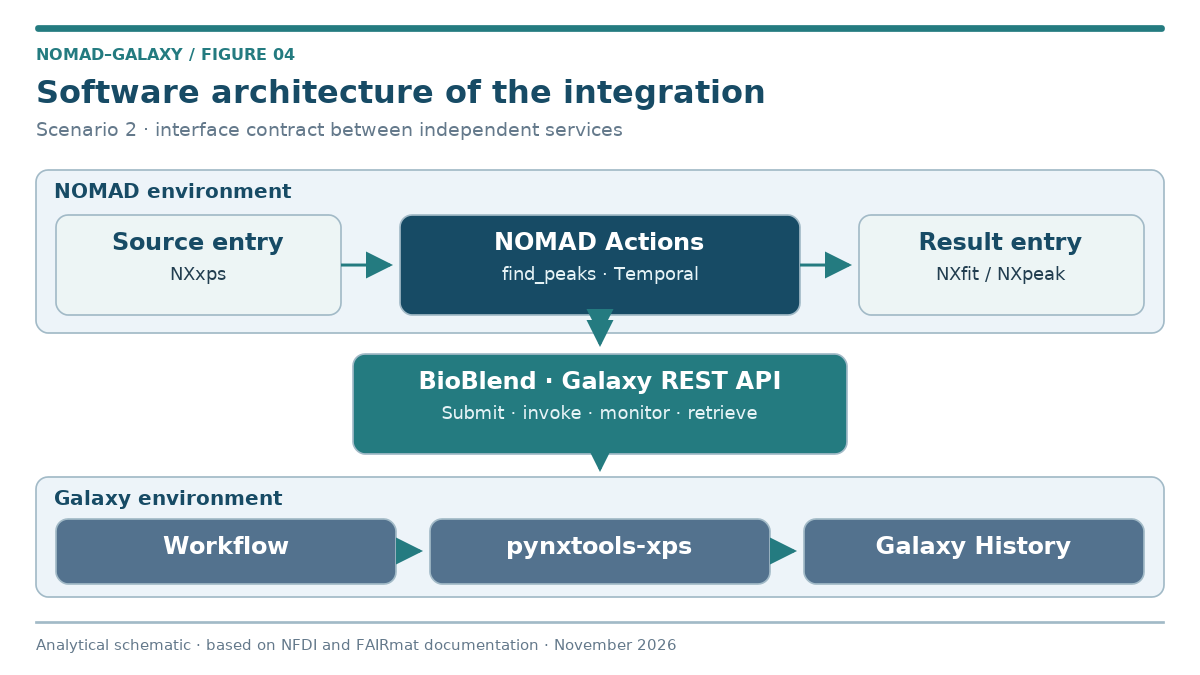
Author’s analytical schematic based on FAIRmat / NOMAD.
7. Provenance and reproducibility
A distributed workflow is scientifically useful when the relationship between the initial data, processing steps and derived data remains inspectable. Galaxy History records input datasets, operations and outputs. NOMAD entries can link the annotated result to the original XPS entry. For the STM pipeline, the source DOI is the principal reference to the published data.
These mechanisms provide the basis for tracing the research process. Long-term reproducibility requires additional decisions: which workflow definition and tool versions should be preserved, how parameters and execution identifiers are recorded, what information about the computing environment is retained, and how input and output files remain accessible after temporary execution storage is removed.
FAIR and reproducibility are related but distinct properties. A machine-readable file and an inspectable workflow are valuable components; neither alone demonstrates the ability to reproduce every result indefinitely.
8. Authentication and access to services
The current integration uses platform-specific API credentials [2, 4]. The XPS Action accepts a user’s Galaxy API key or can use a configured deployment-level credential. The plugin documentation describes secret handling through the generic Actions form; a key should not be stored as ordinary laboratory metadata or published with the dataset.
The separate NFDI Galaxy–EOSC use case [7] describes federated authentication, access to distributed computing resources and external data sources. These capabilities indicate a direction for future integration. They are distinct from the documented NOMAD–Galaxy workflow: the latter does not, by itself, establish EOSC-wide single sign-on or execution on EOSC EU Node resources.
Federation-wide service operation also involves service registration, access policies, user support, monitoring and defined operational responsibilities.
9. Reproducing the demonstrator
The developers provide an open repository and a two-part tutorial [5, 6]. The first part tests the Galaxy-side round trip using a local Python environment with uv, a Galaxy account and a test NeXus spectrum. It imports the workflow, submits the input, monitors processing and downloads the result. NOMAD and Temporal are not needed for this partial test.
The second part requires a working NOMAD deployment with the plugin, Temporal, an action worker and a suitable XPS entry. It exercises the complete NOMAD-to-Galaxy-to-NOMAD process. The tutorial describes the expected creation of a linked entry with additional peak data.
The repository contains the following materials for practical study. The presence of the code and example files supports independent testing; this review has not executed the workflow. An implementation should pin the software version used and document the actual execution result.
| Digital object | Purpose |
|---|---|
vms_regular_ref.nxs | Input test spectrum |
Galaxy-Workflow-XPS_peak_finding.ga | Machine-readable workflow |
galaxy_client.py | Galaxy API interaction |
import_workflow.py | Workflow import |
test_galaxy_roundtrip.py | Round-trip test |
roundtrip_result.nxs | Expected generated output (not an input file) |
10. Significance for the EOSC Federation
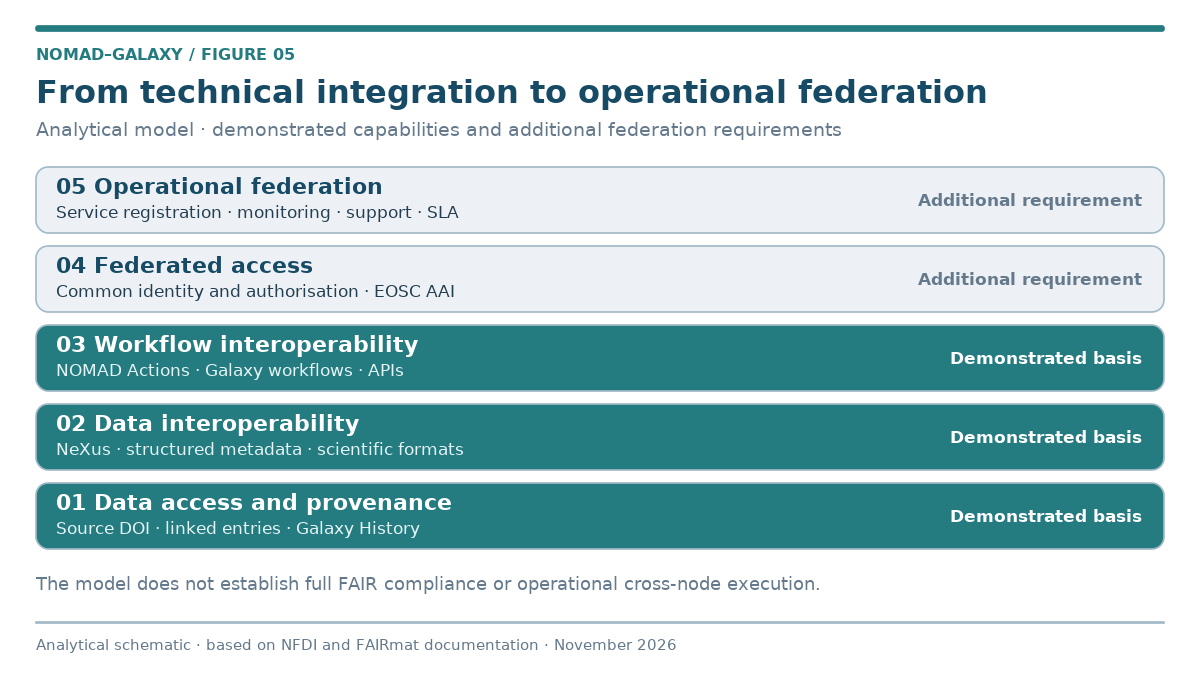
The demonstrator offers a concrete pattern for combining data and analysis services without merging their software or institutional governance. It illustrates two directions of interoperability: between a general repository and a domain-specific data platform, and between a data platform and an external scientific workflow service.
The documented examples were developed in preparation for EOSC Node Germany. They demonstrate technical cross-platform interaction. A claim of operational cross-node execution between two fully onboarded EOSC nodes would require additional evidence of the participating nodes, service registration, federated identity, execution resources and agreed operational arrangements.
Further developments can extend the approach to additional experimental techniques and more complex workflows. An important challenge will be to combine scientific interoperability with dependable federated operation, including support, monitoring and service-level commitments.
| Capability | Evidence status |
|---|---|
| STM conversion and publication | Documented demonstrator |
| XPS Galaxy round trip | Implemented and documented |
| EOSC AAI / EOSC EU Node compute | Not verified for this workflow |
| Cross-node production operation | Additional evidence required |
Author’s analytical schematic based on FAIRmat / NOMAD.
Conclusion
The NOMAD–Galaxy demonstrator illustrates a transition from making research data available to enabling their use across independent digital research infrastructures. Its two scenarios combine data harmonisation, remote scientific analysis and links between primary and derived data. The open software, test data and documentation make the approach accessible for independent study. The next step for the wider federation is to connect such technical integrations with common access and operational arrangements.
Sources and further reading
- FAIRmat. NOMAD–Galaxy integration at EOSC Symposium 2026 (22 October 2026)
- NFDI. NOMAD: Connecting data and analysis
- NOMAD–Galaxy plugin documentation
- Technical explanation and interface contract
- FAIRmat-NFDI. Source code and citation
- Tutorial: Galaxy-side and complete round trip
- NFDI. Galaxy: EOSC use case
- Software citation (v0.1.0, as listed in repository)
- pynxtools-xps documentation
- European Galaxy Server
- pynxtools-spm source code
Practical resources
Official use case
Plugin and example files
Architecture and configuration
Two levels of testing
Workflow execution
Research data platform
Keywords: EOSC, FAIRmat, NOMAD, Galaxy, Zenodo, NeXus, FAIR workflows, provenance, interoperability, materials science.