FAIRmat II and NOMAD 2.0: A New Stage in Digital Infrastructure for Materials Science
27.11.2026
On 1 October 2026, FAIRmat entered its second funding period within Germany’s National Research Data Infrastructure (NFDI). On 23 October, the consortium announced NOMAD 2.0, a major release of its open-source research data management platform.
These developments illustrate the expanding role of domain-specific digital infrastructures. Growing collections of FAIR data, common data models and automated processing provide a foundation for wider use of machine learning and artificial intelligence in materials science.
1. FAIRmat within Germany’s research infrastructure landscape
FAIRmat (FAIR Data Infrastructure for Condensed-Matter Physics and the Chemical Physics of Solids) is an NFDI consortium established in 2021. It addresses data from materials synthesis, experiments, theory and computational research. Its technological foundation is the NOMAD ecosystem, which grew out of computational materials science infrastructure.
During the first period, tools for computational data were complemented by experimental documentation, electronic laboratory notebooks (ELNs), metadata extraction and locally hosted installations. On 10 July 2026, Germany’s Joint Science Conference (GWK) approved continued funding. The number of principal investigators increased from 58 to 90. FAIR-DI announcements of 10 July and 1 October 2026.
2. FAIRmat II: structure and areas of activity
Seven task areas combine domain expertise with shared infrastructure functions. Synthesis, experiment and computation remain the scientific pillars. In the second period, data modeling and interoperability became a separate Area D, while Area F was established to enable data-driven science. Official FAIRmat structure.
| Task area | Main activities |
|---|---|
| A. Synthesis | Documentation of synthesis and materials processing. |
| B. Experiment | Measurement standardization and instrument integration. |
| C. Computation | Computational data models and reproducibility. |
| D. Data Modeling and Interoperability | Models, standards, quality and workflows. |
| E. Digital Infrastructure | NOMAD operations, federation and computing. |
| F. Enabling Data-driven Science | AI-ready data and model evaluation. |
| G. Outreach | Training, support and partnerships. |
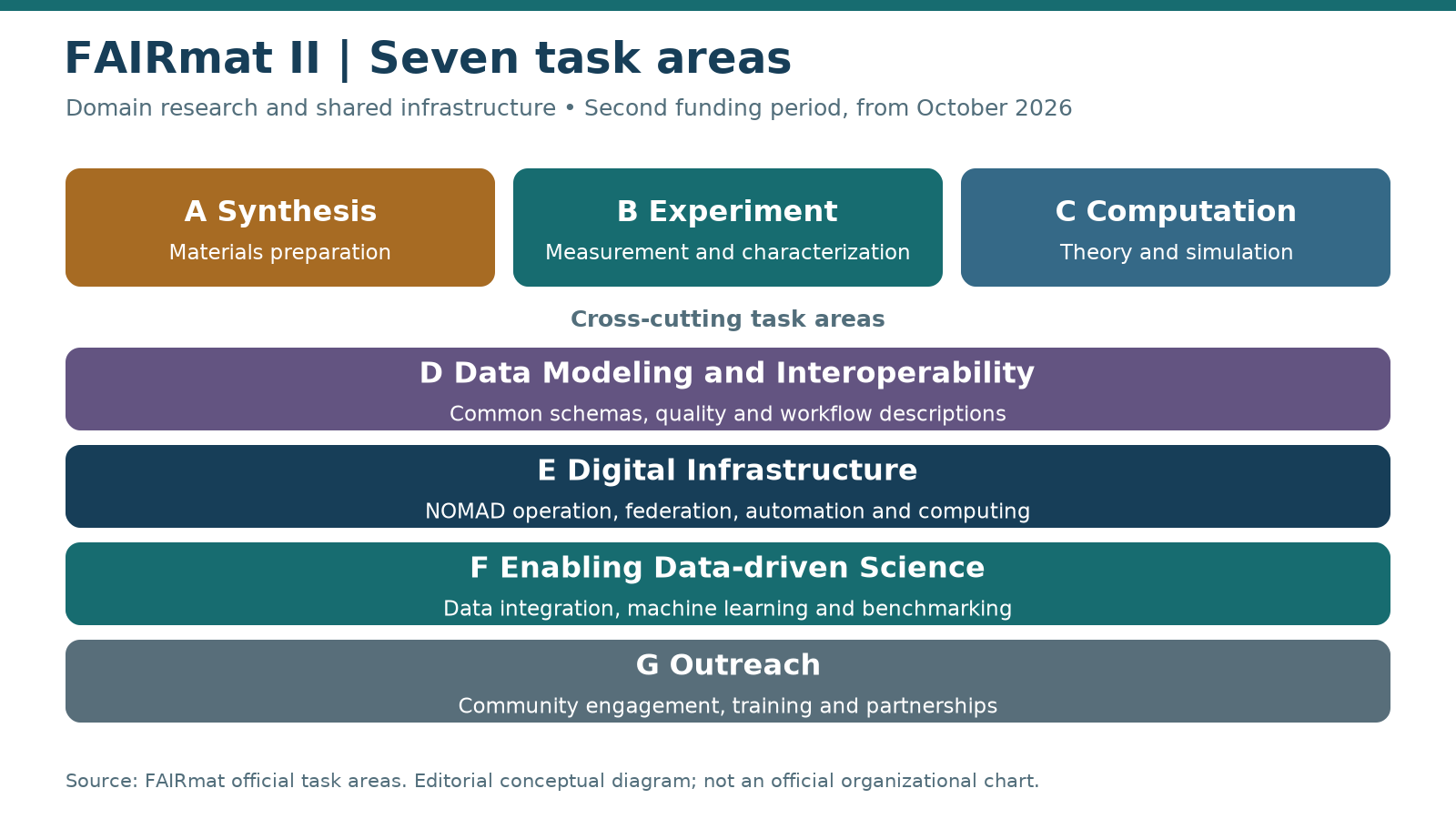
Editorial diagram based on the official FAIRmat structure; not an official organizational chart. Source.
3. Semantic interoperability and research data quality
Materials research methods use different file formats, terminology and documentation practices. Joint analysis requires consistent descriptions of scientific objects, methods, parameters and the conditions under which results were obtained.
D1 — data models and standards. Alignment of schemas with ontologies, vocabularies, external standards and APIs.
D2 — data quality and curation. Methods to assess metadata completeness, reliability and consistency, including representations of uncertainty and error.
D3 — workflows. Machine-readable representations of research operations that can be exchanged, connected and reused. These are work programme objectives, rather than evidence that all methods have already been standardized. Area D overview.
4. NOMAD 2.0: organizing research data around projects
NOMAD is an open-source platform for documenting, storing, searching, analysing and publishing data. Version 2.0 makes Projects the main organizational unit in the user interface, replacing the earlier user-facing concept of Uploads.
A project brings together data entries, collaborators and publication workflows. The redesigned interface makes electronic laboratory notebooks and data exploration easier to use. For supported formats, parsers extract and structure scientific information. Plugins can add formats, schemas, analysis tools and specialized interfaces.
Projects can be assigned a DOI to facilitate citation. In self-hosted installations, publication and DOI capabilities depend on configuration. NOMAD 2.0 announcement · Release notes.
5. The distributed NOMAD infrastructure
NOMAD Central provides public research data search and publication services. NOMAD Oasis allows institutions to deploy the same software on their own infrastructure, with local control over access, plugins and integrations. Publication from Oasis to Central depends on configuration and applicable procedures.
In FAIRmat II, Area E comprises four tasks: E1 — operation of central services; E2 — federation and data exchange across Oasis installations; E3 — instrument control and experimental automation using NOMAD CAMELS; and E4 — integration of AI, high-performance computing (HPC) and distributed resources. These are development priorities; some capabilities are already available, while others require further integration.
Oasis administrators upgrading to version 2.0 need to check compatibility and follow the migration procedures. NOMAD Oasis · Area E · Migration guide.
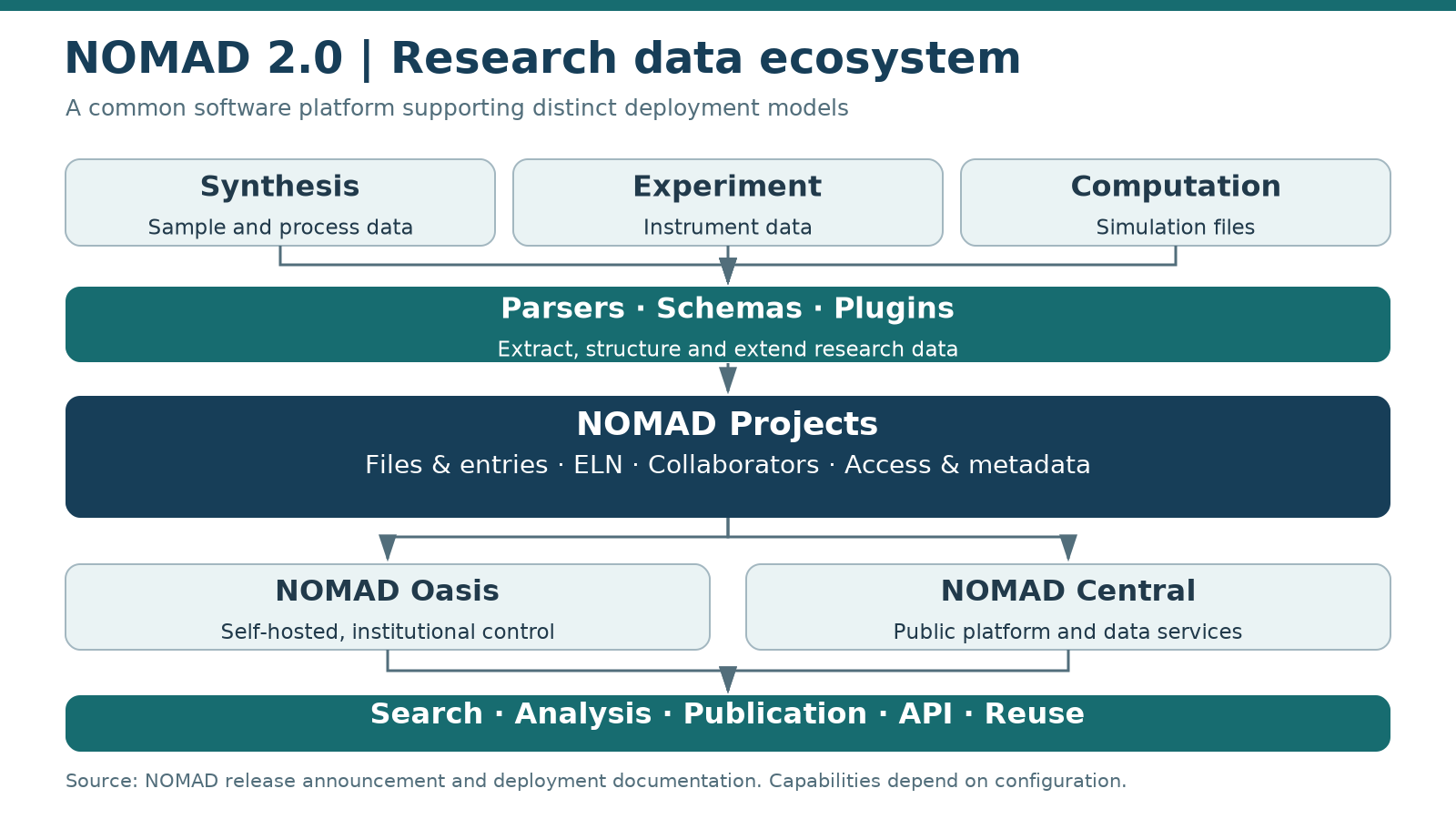
Editorial diagram based on NOMAD documentation. Capabilities depend on configuration. Source.
6. From FAIR data to data-driven science
Area F connects available data with machine learning methods. F1 addresses selection, curation and integration of training data; F2 focuses on automated experimental analysis, feedback during measurements and autonomous workflows; F3 develops model evaluation methods and community benchmarking challenges. Area F overview.
Making data AI-ready requires assessing fitness for a specific task, including parameter consistency, quality, uncertainty, representativeness and sound evaluation procedures. FAIR compliance is an essential foundation, but it does not by itself establish whether a dataset is suitable for training a particular model.
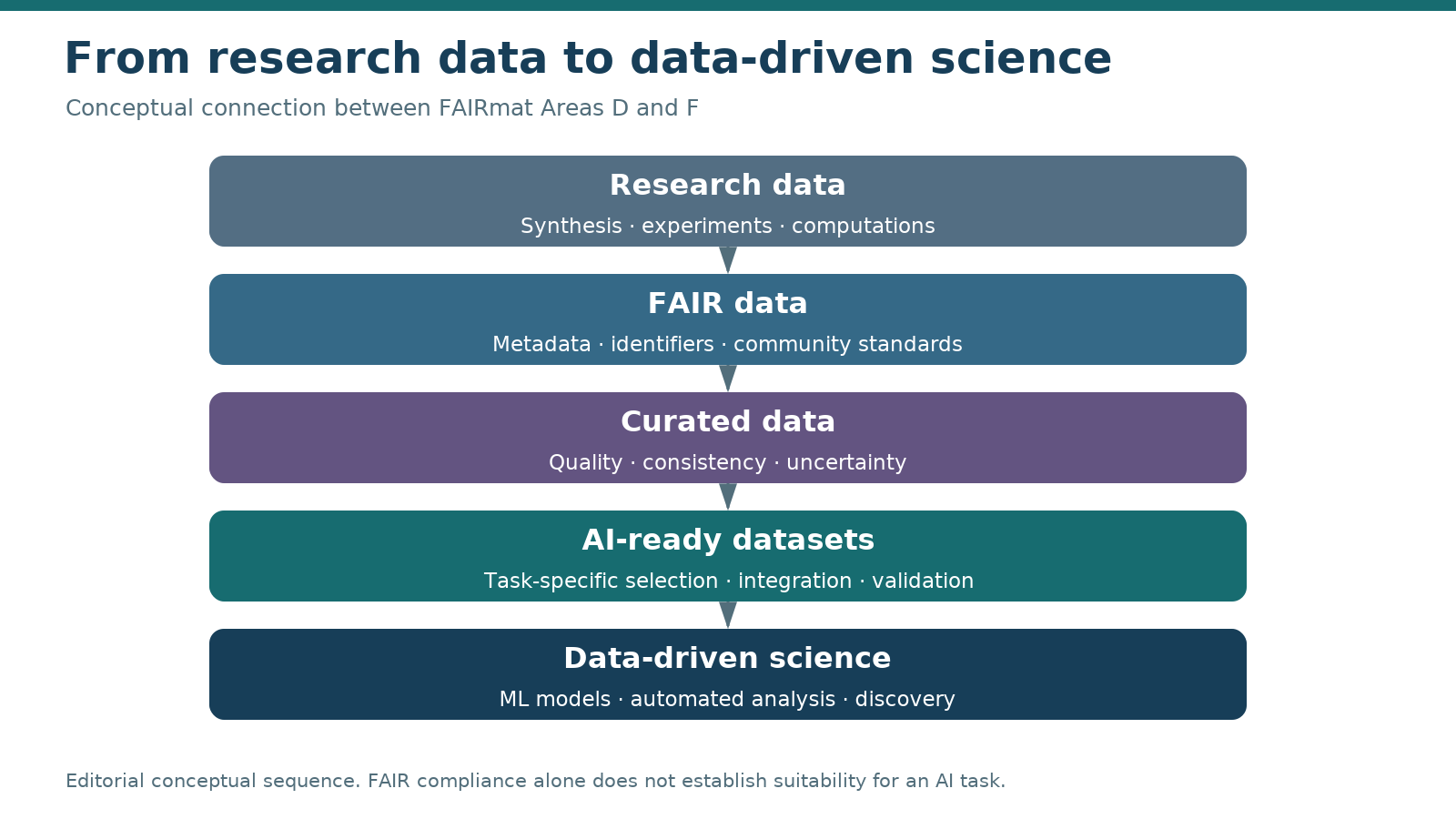
Editorial synthesis of Areas D and F; AI readiness is task-specific. Source.
7. Integration with European research infrastructures
EOSC Node Germany. An initial NOMAD–Galaxy demonstrator was presented in October 2026: it standardizes open microscopy data and analyses spectroscopy data with results returned to NOMAD. NFDI use case.
MatOSC. FAIRmat joined the Lausanne workshop on 13–14 July, focused on preparing a thematic EOSC node for materials science. MatOSC project overview.
MaterialsCommons. This Horizon Europe project (2026–2030) aims to connect academic and industrial advanced materials research resources. NOMAD is among the infrastructures planned for early integration. CORDIS: Grant 101293545.
These three initiatives illustrate national, thematic and cross-sector integration. Pilots and project participation do not establish that onboarding to the EOSC Federation has been completed.
8. Researcher support and practical use cases
Area G covers community engagement, training and partnerships. In July 2026, FAIRmat introduced DMP4PS, a data management planning service for physical sciences based on RDMO, and NOMAD Gallery, a collection of practical use cases linking scientific tasks to data, software and publications.
The European Digital Skills Award 2026 recognized FAIRmat’s training work in the workplace upskilling category. Area G · FAIR-DI news.
Conclusions
The second FAIRmat funding period and the release of NOMAD 2.0 illustrate the expanding role of domain-specific infrastructure. Data storage, documentation and publication are complemented by standardization, quality assessment, automated processing and preparation for machine learning.
The FAIRmat model combines domain expertise, shared software infrastructure and skills development. Further European integration depends on alignment of standards, access rules and operational procedures across independent infrastructures.
Sources and further reading
- FAIR-DI – news (2026)
- FAIRmat – structure
- Area D – Data Modeling and Interoperability
- Area E – Digital Infrastructure
- Area F – Enabling Data-driven Science
- Area G – Outreach
- NOMAD 2.0 – release notes
- NOMAD 2.0 – migration guide
- NOMAD Central
- NOMAD Oasis
- NOMAD Gallery
- DMP4PS
- MatOSC
- MaterialsCommons – CORDIS
Keywords: FAIRmat, NOMAD, NFDI, FAIR, EOSC, MaterialsCommons, MatOSC, materials science, interoperability, artificial intelligence.