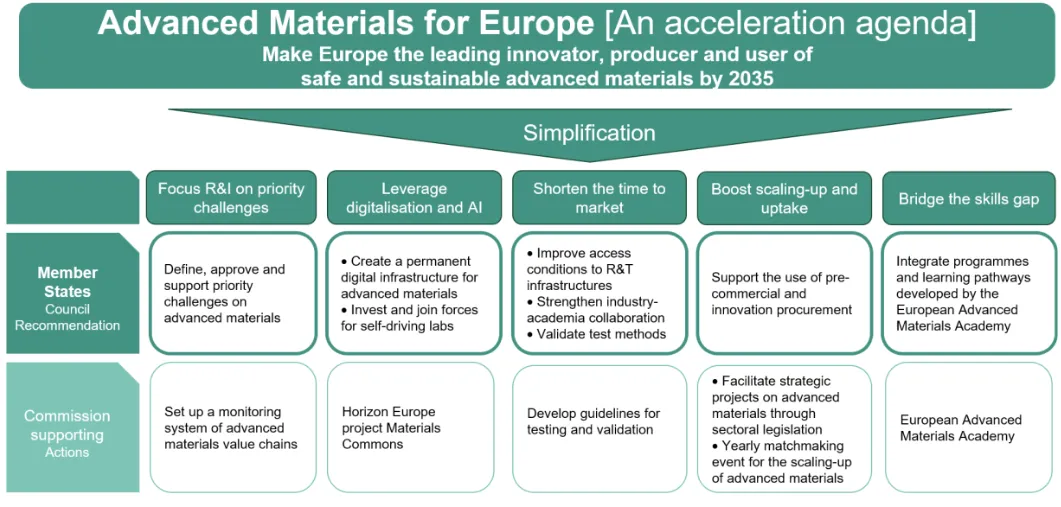
The European Commission has presented a new policy framework for advanced materials, bringing together research and innovation, digital infrastructures, artificial intelligence, industrial deployment and skills development.
On 18 November 2026, the European Commission presented the Advanced Materials for Europe package, consisting of a proposal for a Council Recommendation on advanced materials — COM(2026) 833 final — and an accompanying analytical document — SWD(2026) 833 final.
The proposal outlines policy objectives and recommended actions for Member States, while the Staff Working Document examines the European advanced materials ecosystem, international competition, research and technology infrastructures, digitalisation, supply chains, patent activity and barriers to industrial deployment.
COM(2026) 833 final
Proposal for a Council Recommendation on Advanced Materials.
SWD(2026) 833 final
Commission Staff Working Document: analytical evidence supporting the proposed policy framework.
The package is a European Commission proposal for a Council Recommendation. It does not constitute an adopted Recommendation or a legally binding regulation. Its implementation would depend on subsequent political decisions and commitments by Member States.
What are advanced materials?
The documents use the OECD working definition of advanced materials: materials deliberately designed to achieve new or enhanced properties, structural characteristics or functional performance.
This category includes both fundamentally new materials and conventional materials whose properties have been substantially improved through new compositions, structures or manufacturing methods.
The proposal identifies several broad classes of advanced materials:
The classification is indicative rather than exhaustive. The definition may be refined in the future, particularly for regulatory purposes.
Strong research capacity, but challenges in industrial deployment
The analytical report describes Europe as one of the world's leading centres of fundamental materials research. Substantial investment has been directed towards advanced materials through European research and innovation programmes.
Advanced materials R&I under Pillar II, 2021–2027
Advanced materials research, 2021–2023
Advanced manufacturing and materials, 2021–2024
Source: SWD(2026) 833 final. The figures refer to different programmes, periods and funding categories and should not be interpreted as directly comparable totals.
The Commission nevertheless concludes that Europe's scientific strengths are not fully translated into patents, industrial scale-up and market uptake.
According to the patent analysis presented in the Staff Working Document, EU companies accounted for approximately 13% of global advanced materials patents between 2010 and 2023, compared with approximately 23% for the United States and 25% for China.
Share of global advanced materials patents, 2010–2023
Source: SWD(2026) 833 final. Selected economies; the remaining global share is not displayed.
European patents nevertheless exhibit a strong international orientation, with a comparatively high share of triadic patent families among patents first filed in the EU.
The report therefore identifies a gap between scientific capability, technological development, scale-up financing and manufacturing. This gap is also reflected in international investment levels.
Estimated advanced materials R&I investment, 2023
Estimated advanced materials R&I investment, 2023
Source: estimates presented in SWD(2026) 833 final.
The EU has a substantial population of innovative specialised small and medium-sized enterprises. However, its share of global advanced materials start-ups is estimated at around 23%, compared with more than 37% in the United States, where companies also attract substantially more capital.
Research and technology infrastructures
Laboratories, research centres, pilot lines, innovation platforms, testbeds, cleanrooms and demonstrators associated with advanced materials. Electronics, energy and mobility are among the principal application areas.
The Staff Working Document identifies a substantial existing infrastructure base across Europe. However, access to these resources remains uneven, with many facilities predominantly serving their own organisations.
Small and medium-sized enterprises, start-ups and scale-ups face difficulties related to the visibility of available services, complex access arrangements and the cost of testing and qualification.
The proposed measures include harmonised access rules, cross-border voucher schemes, improved visibility of available services, simplified contractual arrangements and better access to infrastructure-generated data.
Digitalisation, research data and artificial intelligence
A central component of the proposed framework is the development of a more integrated digital environment for advanced materials research.
Europe already has a range of relevant platforms and initiatives, including Materials Cloud, NOMAD, FAIRmat, MaX, MaterialDigital, DIADEM and CAPeX. The analytical document identifies fragmentation and insufficient interoperability as continuing challenges.
Towards a federated digital materials ecosystem
European Open Science Cloud: discovery, access and interoperability of research resources.
A proposed permanent digital R&I infrastructure for advanced materials data, tools and knowledge.
Conceptual representation of the connections envisaged in the Commission's proposal; not an official technical architecture.
Materials Commons and EOSC
The Commission proposes consolidating Materials Commons as a permanent European federated digital research and innovation infrastructure for advanced materials data, tools and knowledge.
By 30 June 2028, Member States would be encouraged to establish its long-term organisational model and funding commitments, with full operational readiness envisaged by 1 January 2030. An ERIC is identified as one possible organisational framework.
National and regional digital infrastructures would progressively be connected to Materials Commons. The proposal also recommends making data generated through nationally funded advanced materials research discoverable and available through both the European Open Science Cloud (EOSC) and Materials Commons, subject to relevant conditions concerning ownership, confidentiality and intellectual property.
FAIR data and FAIR+
The proposed framework emphasises high-quality research data that follow the FAIR principles: Findable, Accessible, Interoperable and Reusable.
In the context of advanced materials, the documents also introduce the FAIR+ concept, extending this approach through relevant safety and sustainability information.
AI-ready data and self-driving laboratories
The proposal places particular emphasis on AI-ready data flows, digital modelling, automated experimentation and self-driving laboratories.
A joint European roadmap for self-driving laboratories in advanced materials is proposed for the end of 2027, with initial infrastructures expected to become operational by 2030.
These laboratories would combine AI models, robotics and automated experimentation, with connections to Materials Commons, RAISE (Resource for AI Science in Europe), pilot lines, testbeds and research and technology infrastructures.
The intended approach establishes feedback loops between data repositories, computational models and experimental facilities, supporting iterative materials discovery, optimisation and qualification.
Industrial competitiveness, trade and strategic dependencies
The analytical report describes an uneven EU position in global advanced materials value chains.
Europe has established strengths in high-value specialised materials, including nanomaterials, advanced polymers and composites. Its position is weaker in certain mass-production segments and categories dependent on critical raw materials.
The EU recorded a positive trade balance in advanced materials in monetary terms, while importing a greater physical volume of materials than it exported.
The report associates these challenges with capital-intensive production processes, lengthy investment and permitting procedures, dependencies on non-European stages of supply chains, and insufficient vertical integration.
Compared with the United States and China, the European manufacturing ecosystem is characterised as more fragmented.