The Finnish EOSC Pilot Node: How a National Open Science Infrastructure Becomes Part of a European Federation
25.05.2026
https://research.csc.fi/eosc-the-finnish-candidate-node/
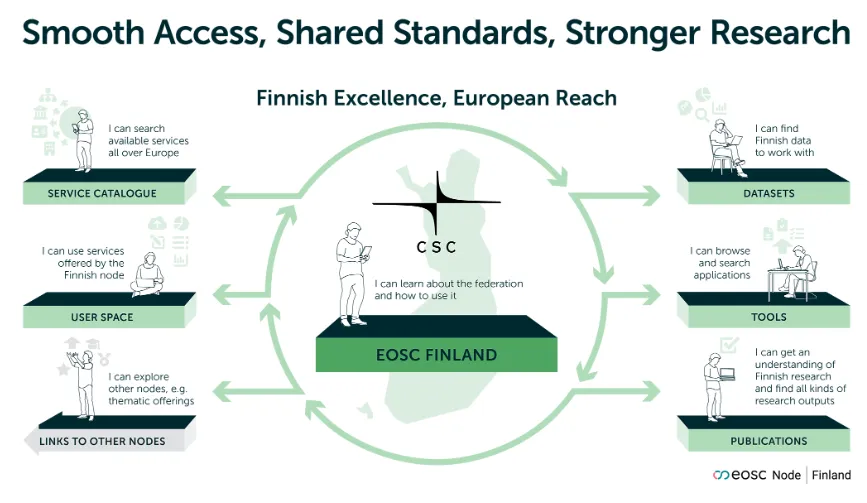
The EOSC Finland Pilot Node page on the CSC – IT Center for Science website is a useful example of how a country can explain its participation in the European Open Science Cloud not through general declarations, but through concrete services for researchers, data providers and research data managers. The Finnish node is presented not as a separate new portal, but as an entry point to an already existing national ecosystem: CSC services, Fairdata, Research.fi, Etsin, service catalogues, access tools, documentation and user support. On the main page, the user immediately sees practical entry points: discover services, start using services, access user guides, find research outputs, discover datasets or browse tools.
This is an important communication approach. The Finnish node does not start by explaining a complex European architecture. Instead, it shows what EOSC can practically provide to a researcher: access to services, data, instructions, tools and support. This reflects the modern understanding of EOSC: it is not “one big cloud” and not a centralized repository, but a federation of existing and new digital resources that operate according to common rules.
A separate CSC page explains that EOSC is an EU initiative for the digital transformation of research, based on the principles of Open Science and FAIR data. In March 2025, EOSC entered the build-up phase, during which thirteen candidate nodes are to be developed and interconnected for the sharing and management of scientific data, knowledge and resources. The Finnish national node is presented as one of these candidate nodes and as one of the future entry points to the EOSC Federation.
The terminology should be explained carefully. In EOSC documents, the term Candidate EOSC Node does not mean a “weak” or merely “nominal” node. It refers to an organisation or consortium that has passed enrolment, has been positively assessed by the Tripartite Governance, and meets minimum legal, organisational and technical requirements, while remaining in Candidate Node status until the EOSC Federation reaches its operational stage. The EOSC Memorandum also clarifies that, for brevity, the term “EOSC Node” is often used during the interim phase, although formally these are still candidate nodes. In this context, the Finnish use of the term Pilot Node can be seen as a communication choice that emphasises practical readiness and the maturity of the first wave compared with newer waves of node enrolment.
One of the strongest features of the Finnish example is the clear separation of target audiences. There is a page for researchers, a page for service providers and data managers, a page explaining the EOSC Federation, a page on MyAccessID, and a page on Dataset-as-a-Service. This structure shows that a national node must be understandable not only to administrators, but also to end users: researchers, data stewards, service engineers, repository operators and project leaders.
The EOSC Finland – Tools for service providers and data managers page shows that a national node is not only a service catalogue for end users, but also a support infrastructure for those who prepare data and services for federation. The page brings together links to Fairdata services, the Research Data Management Competence Center, requirements for trusted repositories, metadata guidance, PID Forum Finland, DataCite Finland, ORCID in Finland, a metadata schema and crosswalk registry, the national vocabulary service Finto, EOSC AAI Architecture, a machine-actionable service catalogue and the EOSC Finland Forum.
The Dataset-as-a-Service concept deserves special attention. It is aimed at publishing metadata about datasets located close to HPC services or within CSC environments. The goal is to make large and valuable datasets visible to researchers, strengthen the connection between research data management and HPC, support data management during active research, link datasets with documentation and tools, and support responsible AI and capacity management. For data providers, the service offers support for data sharing planning, the possibility to publish use copies outside repositories with references to master data, dataset visibility, documented lifecycle and terms of use. For data users, it provides the ability to discover large datasets that were previously “in the dark”, better data lineage tracking, recommended tools and support for citation.
This is a particularly important lesson. Not all large datasets must necessarily be physically transferred into a single repository. Some datasets may remain in HPC, cloud or laboratory environments, but through metadata, access conditions, lifecycle description, links to master data, analysis tools and citation mechanisms, they become visible and reusable. For Ukraine, this may become a promising direction: Dataset-as-a-Service for DataverseUA, institutional storage systems, shared equipment centres, computational environments and thematic digital infrastructures.
It is also important that the Finnish model includes not only descriptions of services, but also a mechanism for access to computational resources. CSC projects that fall under the free-of-charge use policy can apply for additional resources — Billing Units and increased quotas. The number of Billing Units should be estimated for a period of 3–6 months, and granted resources can be used across all services that consume Billing Units. The process of increasing quotas depends on the service, while applications are divided by size: small applications are processed immediately, medium applications are usually reviewed within 1–3 days, and large requests are reviewed every three weeks by the Resource Allocation Group. Large requests are assessed based on scientific effectiveness and quality, taking into account Finnish national science policy and government priorities.
This element is crucial. The node does not merely “display” services. It introduces rules for access to resources, quotas, application procedures, responsibility, appeals and alignment with national scientific priorities. This is where the difference between a mature digital infrastructure and an informational portal becomes visible: a service must have not only a description, but also rules of use, a resource allocation mechanism, support, monitoring and workload management.
Another strong element is the service catalogue. The Finnish page allows users to browse services across nodes and distinguishes between open access, restricted access, EU node and Finnish node services. The catalogue includes services for data, storage, transfer, cloud computing, sensitive data, software, FAIR publication and research information.
The main lesson of the Finnish node is that EOSC is not a repetition of the old model of a “central node” where all resources are subordinated to one platform. It is a federation of trusted participants who preserve their autonomy but agree to common rules: FAIR, AAI, catalogues, metadata, PIDs, service management, user support, monitoring, transparent access conditions and resource allocation rules. Trust is created not as trust in a single corporation or one central point of control, but as trust in a shared infrastructure for the common good.
For the National Academy of Sciences of Ukraine, this example is important because a future NASU node should not be reduced to the scheme “federation of repositories + a CRIS system such as RIT NOD + a central metadata harvester”. Repositories, CRIS/RIS components, aggregators and harvesters are necessary elements, but they do not exhaust the function of a node. A node must be a service-oriented and organisational infrastructure: it should bring together repositories, DOI/PID services, metadata, AAI, a service catalogue, helpdesk, monitoring, provider onboarding, access rules for computational and data resources, training, data stewardship, thematic workflows and use cases. In other words, it is not only about “collecting metadata”, but about a governed system that allows a researcher to find a resource, gain access, use a service, publish a result and ensure its reuse.
This is the logic that should guide the formation of a NASU node. DataverseUA, RIT NOD, institutional resources, shared equipment centres, cloud and computing services of the Bogolyubov Institute for Theoretical Physics, thematic digital infrastructures and training programmes of the Competence Centre should not be treated as separate “showcases”. They should be seen as components of a common service ecosystem. Its value will be determined not by the number of connected websites, but by whether a Ukrainian researcher can follow the full open science route: prepare data, describe them, obtain an identifier, find or provide a service, use a computational or analytical resource, receive support, publish the result and make it visible to the European EOSC Federation.
CSC Resources for Free-of-Charge Use
| Resource group | Services / resources | What is provided | Conditions / limitations |
|---|---|---|---|
| HPC computing | Puhti, Mahti | High-performance computing for academic research, teaching and related use cases | Use is limited by project Billing Units and quotas; additional resources are requested through MyCSC |
| Notebook environment | Noppe | Interactive notebook environments for teaching, data analysis and research scenarios | Courses and MOOCs may have separate conditions or be reviewed case by case |
| Object storage | Allas | Storage, transfer and sharing of large datasets | Typical starting quota is 10 TiB; increase to 50 TiB is a medium request, increase to 200 TiB is a large request |
| Cloud resources | cPouta, ePouta | Virtual machines, cores, memory, storage and floating IPs; ePouta is intended for more isolated environments | Typical basic quotas: 8 instances, 8 cores, 32 GiB memory, 2 floating IPs, 1 TiB storage |
| Container / platform services | Rahti | OpenShift projects, pods, containers and storage for application deployment | Typical quotas: 5 OpenShift projects per user, 20 pods per project, 2 virtual cores per pod/container, 8 GiB memory per pod/container |
| Database / backup services | Pukki | Databases, backups and volume reservation | Typical quotas: 5 database instances, 1000 manual backups, 20,000 MB memory usage, 50 GiB volume reservation |
| Software / analysis tools | Chipster, partly other tools | Tools for data analysis, especially bioinformatics and data analysis workflows | Access depends on the project type and CSC service conditions |
| Sensitive data services | Sensitive Data Connect, Sensitive Data Desktop | Controlled environments for working with sensitive data | Access is governed by separate conditions for sensitive data |
| Fairdata services | IDA, Qvain, Metax, Etsin | Storage, description, publication and discovery of research data | Available under specific conditions for users from Finnish higher education institutions, state research institutes and their collaborators; Fairdata PAS requires a separate agreement |
Additional Billing Units Packages
| Application type | Resource amount | Review process |
|---|---|---|
| Small resource application | 60,000 CPU BU; 10,000 GPU BU; 30,000 Cloud BU; 30,000 Storage BU | Processed immediately after submission, but all applications are monitored |
| Medium resource application | Up to 600,000 CPU BU; up to 100,000 GPU BU; up to 300,000 Cloud BU; up to 300,000 Storage BU | Usually reviewed within 1–3 days by a Resource Officer |
| Large resource application | Up to 6,000,000 CPU BU; up to 1,000,000 GPU BU; up to 3,000,000 Cloud BU; up to 3,000,000 Storage BU | Reviewed by the Resource Allocation Group approximately every three weeks; scientific quality and efficiency are assessed |